

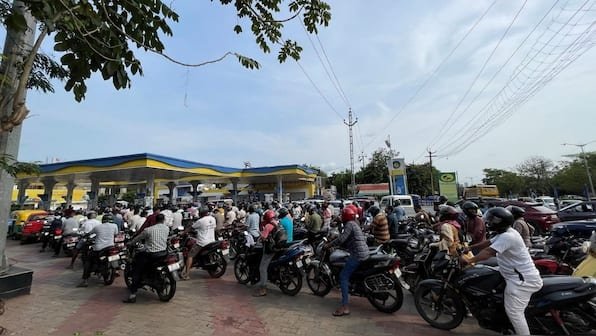
Consumers are bracing for further economic strain as economists warn that petrol and diesel prices could surge by another ₹10 per litre in the coming weeks. The warning follows a sudden ₹3 per litre hike implemented on Friday by India’s state-run Oil Marketing Companies (OMCs), marking the first major domestic fuel price increase in four years.
The sharp upward revision is a direct consequence of the ongoing war in West Asia involving Iran, which has sent global crude oil prices soaring into the $105–$110 per barrel range.
Why a ₹10 Hike is on the Horizon
According to a report by financial services firm Emkay Global, the recent ₹3 increase is far from enough to stabilize the domestic energy sector:
-
Massive Under-Recoveries: OMCs are currently losing an estimated ₹17 to ₹18 on every single litre of fuel sold at the pumps.
-
Unsustainable Deficits: Even with the Union government cutting excise duties on fuel imports by ₹10 per litre on March 27, 2026, OMCs are projected to lose a staggering ₹57,000 to ₹58,000 crore this quarter alone.
-
The Staggered Outlook: To recover at least half of these mounting losses, analysts expect OMCs to execute a cumulative ₹10 price hike, either in a single announcement or through smaller “creeping” increases over the next two to three weeks.
The Double Whammy: Milk and CNG Also Rise
The fuel shock arrives alongside a broader increase in the cost of basic household commodities, dealing a heavy blow to middle-class budgets:
-
Dairy Prices: India’s leading dairy cooperatives, Amul and Mother Dairy, have already raised milk prices by ₹2 per litre. This marks their second price increase within the last 13 months and is expected to trigger similar hikes by regional brands.
-
CNG Prices: Compounding the transit crisis, Indraprastha Gas Ltd (IGL) hiked CNG prices by ₹2 per kg in Delhi, mirroring a matching increase implemented across the Mumbai Metropolitan Region.
The Inflation Impact: How Much More Will You Pay?
Economists caution that the combined surge in fuel, gas, and milk prices will trigger a significant rise in Consumer Price Inflation (CPI).
| Economist / Institution | Key Projections & Observations |
| Megha Arora (India Ratings & Research) | The combined direct impact of petrol, diesel, and milk will lift CPI inflation by 0.42% in the coming months. |
| Radhika Rao (DBS Bank) | The direct 3–5% increase in pump prices alone will add 0.15% to 0.25% to headline inflation. |
| Rajani Sinha (CareEdge Ratings) | Direct fuel impacts will add 0.15%, while secondary transport and food logistics costs will add another 0.10% to 0.15%, pushing average inflation toward 4.6%–5.0%. |
| Santosh Mehrotra (Economist) | For every $10 increase in global crude, the domestic CPI ticks up by 0.3%, while simultaneously widening India’s current account deficit by 0.3% of the GDP. |
The Domino Effect on Daily Life
While the immediate direct impact will be felt at the fuel pumps and grocery counters, the broader “second-round” inflationary damage will gradually trickle down to the common person over the next few months. Higher diesel costs will inevitably translate into increased freight charges for commercial trucks, driving up the retail cost of vegetables, fruits, and FMCG products.
Furthermore, commuting costs are set to rise sharply as cab aggregators, auto-rickshaw operators, and public transport networks adjust their fares to cope with the steep spike in petrol, diesel, and CNG rates.
