

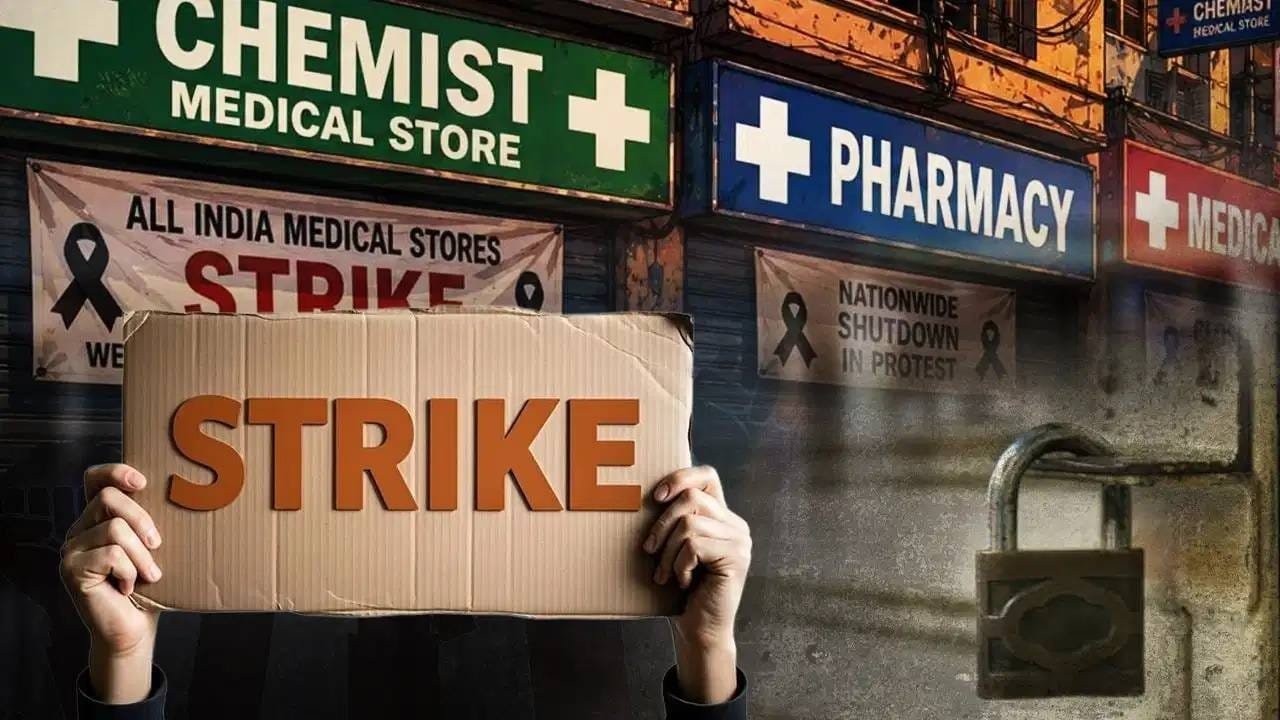
India’s pharmaceutical distribution network is facing widespread disruption today, Wednesday, May 20, 2026, as the All-India Organisation of Chemists and Druggists (AIOCD) executes a 24-hour nationwide strike. The massive protest involves a significant portion of the association’s 12.4 lakh member network of chemists, pharmacists, and drug distributors, shutting down an estimated 9.8 lakh traditional retail medical shops across the country.
The national strike has begun on a mixed note across various states. While retail neighborhoods are seeing extensive shuttered storefronts, state drugs control administrations have moved quickly to keep alternative supply channels active to prevent a public healthcare crisis.
Why the Chemists Are Protesting: The Core Demands
Traditional brick-and-mortar pharmacies argue that the prolonged absence of a definitive legal structure has allowed corporate-backed e-pharmacies and instant delivery apps to function with a distinct unfair advantage. The AIOCD’s primary agitation centers around forcing the Central Government to immediately withdraw two specific regulatory provisions:
-
GSR 817(E) (The Permanent Grey Zone): Originally introduced eight years ago as a draft notification to map out a formal registration, verification, and penalty framework for online pharmacies, this policy was never officially finalized. The AIOCD argues this indefinite delay has allowed digital platforms to comfortably scale up operations without real statutory accountability.
-
GSR 220(E) (The Expired Emergency Loophole): Rolled out by the Ministry of Health and Family Welfare as a temporary crisis measure during the COVID-19 pandemic, this notification allowed registered pharmacies to doorstep-deliver medicines. Retail chemists claim online corporate groups are now exploiting this pandemic-era relaxation as a permanent legal shield to bypass strict offline retail protocols.
Public Health Risks and Financial Headwinds
Beyond statutory definitions, traditional retail owners are raising serious alarms regarding public safety and economic survival.
“A medicine is not a regular market commodity. Once consumed, it has lasting physiological impacts,” stated Rajiv Singhal, General Secretary of the AIOCD.
The association highlighted alarming operational gaps where online apps allegedly fulfill critical orders based on unverified, fake, or improperly processed prescriptions—frequently issued by unregistered out-of-state practitioners. This lack of verification, the body warns, severely accelerates the unsupervised circulation of high-risk antibiotics and scheduled controlled substances.
On the financial front, neighborhood chemists are pushing back against predatory pricing strategies. Corporate e-pharmacies routinely deploy vast capital reserves to offer deep discounts ranging from 20% to over 50%. Small neighborhood retailers, whose operational margins are structurally locked between 10% and 12%, find themselves entirely priced out while grappling with rising storefront rents, electricity costs, and staff salaries.
Emergency Workarounds: How to Get Medicines Today
Despite the AIOCD proceeding with the strike after inconclusive meetings with the Central Drugs Standard Control Organisation (CDSCO), essential emergency medical services remain functional. To minimize patient distress, state governments and regional authorities have put emergency contingency measures into effect:
-
Hospital Pharmacies: All medical shops physically attached to government and private hospitals remain open 24/7 to handle critical emergencies and inpatient requirements.
-
Corporate Pharmacy Chains: Major organized pharmacy chains, including Apollo Pharmacy and MedPlus outlets, are fully operational.
-
Jan Aushadhi Kendras: Government-run generic medicine centers remain open to cater to regular public needs.
-
District Coordination: Local drug inspectors are working alongside district pharmacy chapters to ensure at least a few neighborhood stores remain on-call to supply life-saving medications locally.
