

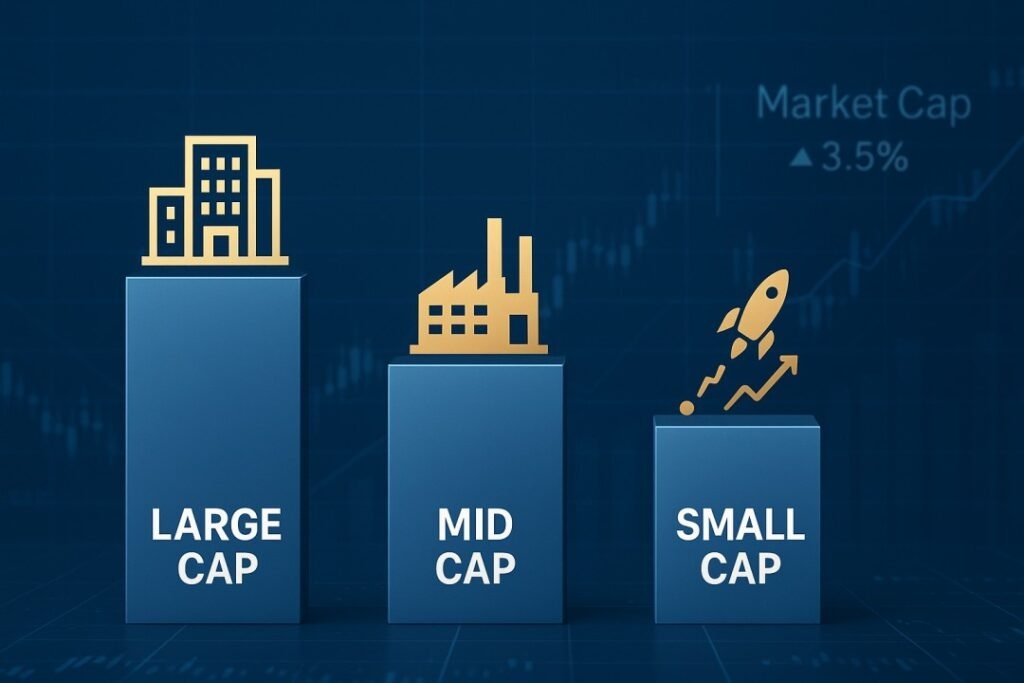
When institutional index indices feel volatile, investor sentiment naturally fractures into two distinct strategies: finding defensive shelter in heavily anchored Nifty 50 large-caps or hunting for alpha recovery inside selective Nifty Smallcap counters.
Relying on emotional stock picking during a volatile week is a recipe for sudden portfolio drawdowns. Instead, institutional platforms use Stock Reports Plus (powered by Refinitiv/LSEG data) to normalize market data across 4,000+ listed stocks. By systematically averaging five distinct core metrics—Earnings, Fundamentals, Relative Valuation, Risk, and Price Momentum—the system creates a normally distributed, standardized score out of 10. This objective scorecard helps separate near-term headline noise from true underlying company strength.
The Divergent Playbook: Blue Chips vs. Smallcap Resiliency
1. Large-Cap Stability (Nifty 50)
During a volatile week, top institutional analysts lean heavily toward Nifty 50 large-caps that showcase “relative strength”—meaning they hold their ground or see active institutional accumulation even when the broader index trends downward.
-
Bharti Airtel: A clear defensive favorite following significant legal clarity regarding legacy liabilities (such as the striking down of the One-Time Spectrum Charge). Backed by robust 5G monetisation and industry-leading Average Revenue Per User (ARPU) metrics, it serves as a highly liquid safe haven.
-
Hindustan Aeronautics Limited (HAL) & Power Finance Corporation (PFC): Major structural capex plays. Driven by near-term delivery catalysts and massive domestic order pipelines, these giants offer a valuation floor that remains highly insulated from global macroeconomic shifts.
-
Apollo Hospitals & Sun Pharma: Classic defensive plays. Healthcare and pharmaceutical champions typically experience consistent institutional accumulation during volatile weeks because their earnings baselines are entirely non-cyclical.
2. Selective Small-Cap Recovery (Nifty Smallcap 100)
Small-cap stocks are traditionally highly sensitive to index swings, meaning a volatile week can create sudden valuation gaps where high-quality micro-businesses are temporarily oversold. Rather than avoiding the space entirely, smart money tracks volume spikes across specific sectors displaying structural recovery:
-
Pharma & Specialty Health (e.g., Wockhardt): Leading near-term small-cap rebounds as money rotates out of high-beta tech and manufacturing into insulated healthcare lines.
-
Real Estate & Infrastructure Proxies (e.g., Anant Raj, NBCC): Tracking strong delivery lines and steady operational cash flows, allowing them to rapidly bounce back from brief index-level corrections.
-
Logistics & Distribution (e.g., Redington, Aegis Logistics): Attracting elevated trading volumes. High buying volume during volatile weeks suggests institutional accumulation is quietly taking place under the surface.
3 Rules for Allocating Capital in Volatile Weeks
-
Look for Volume Clues: If a stock finishes flat or positive on high trading volume while the broader Nifty 50 falls, institutional buyers are likely accumulating shares.
-
Check the Fundamental Floor: Ensure your small-cap allocations possess strong quantitative scores in Stock Reports Plus—specifically focusing on steady cash flows and manageable debt-to-equity ratios.
-
Avoid Over-Leveraged Narratives: High-flying stocks that miss their Q4 earnings targets are being heavily penalized by the Street. Stick to companies where current pricing is backed by immediate earnings visibility rather than distant growth promises.
