

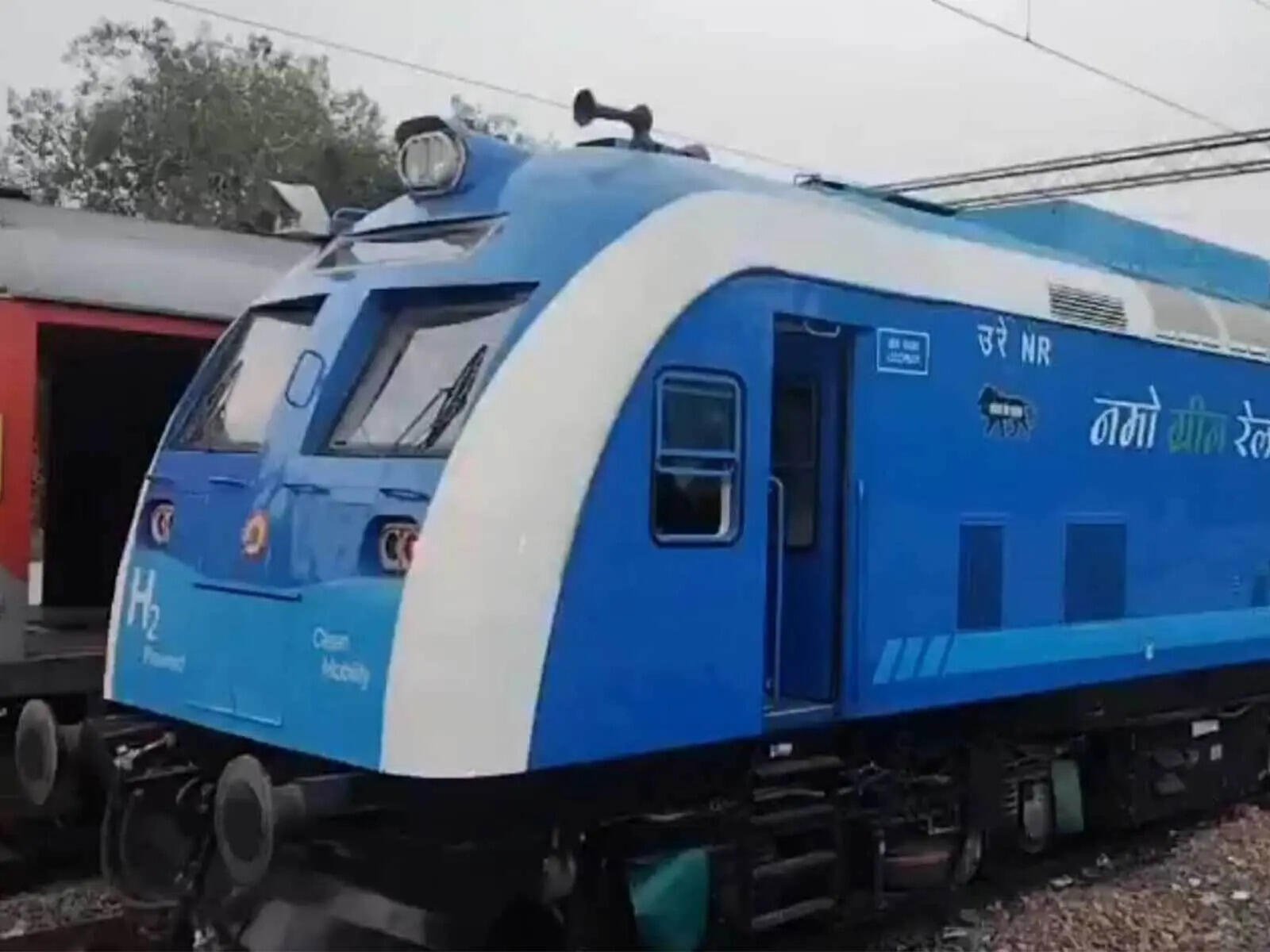
This project involves retrofitting existing Diesel Electric Multiple Unit (DEMU) rakes with cutting-edge clean tech. Instead of burning diesel, these modified trains combine onboard hydrogen with atmospheric oxygen to generate their own electricity, emitting nothing but clean water vapor and heat.
Fast Facts: The Indian Pilot Project
-
The Powerhouse: The 10-coach train features two $1,200\text{ kW}$ Driving Power Cars, making it the longest and most powerful hydrogen trainset in the world on a broad-gauge line.
-
Speed Limits: While it touched a top speed of $120\text{ km/h}$ during testing, its commercial operational speed will be capped at $75\text{ km/h}$.
-
Range & Fueling: The train can cover roughly $250\text{ km}$ on a single fueling cycle. It is supported by a dedicated Jind refueling plant equipped with a $1\text{ MW}$ polymer electrolyte membrane (PEM) electrolyser capable of churning out up to $430\text{ kg}$ of hydrogen daily.
-
The Blueprint: Because standard overhead line electrification is highly efficient, Indian Railways is reserving these expensive hydrogen trains specifically for difficult terrains and its “Hydrogen for Heritage” routes (like Darjeeling or the Kangra valley).
Understanding the Internal Mechanics
As illustrated in the powertrain graphic above, the system relies on a delicate balance of three core components:
-
The Hydrogen Tank: Stores the fuel under intense compression ($350\text{ to }700\text{ bar}$).
-
The Fuel Cell: Acts like “electrolysis in reverse,” blending the compressed hydrogen with ambient oxygen to generate a continuous electrical current.
-
The Battery System: Acts as a crucial buffer. It captures energy recovered through regenerative braking and stores surplus electricity from the fuel cell, stepping in to provide an extra power boost during heavy acceleration.
The Hurdles Ahead
While a triumph for localized clean emissions, scaling up hydrogen rail transport presents steep hurdles:
-
Production Costs: True sustainability requires “green” hydrogen—split using entirely renewable energy. Today, most global supply remains “grey” (derived from natural gas), and building green infrastructure is incredibly capital-intensive.
-
Hydrogen Embrittlement: Hydrogen has a microscopic molecular size, allowing it to slowly permeate and weaken standard metal storage cylinders over time. This requires a costly industry shift toward advanced composite materials.
-
Climate Stresses: The fuel cells will face intense operational scrutiny under India’s extreme seasonal temperature swings, which are far harsher than the temperate European climates where hydrogen trains have successfully run since 2018.
