

For years, the mechanical keyboard market has been heavily saturated with aggressive gamer aesthetics, glowing RGB matrices, and loud, clacky switches designed more for loud LAN parties than quiet, focused productivity. It is refreshing, therefore, when a major brand steps outside that mold to build something tailored specifically for minimalists, writers, and desktop enthusiasts who prioritize design and tactile feedback.
Priced at ₹8,999, the ASUS Jelly75 enters a fiercely competitive bracket in the Indian market. While it faces stiff competition from established enthusiast brands, its unique mix of a semi-transparent chassis and refined out-of-the-box performance makes it a compelling option for those who want a premium typing experience without spending hours modding or lubing components manually.
Striking Visuals and a Solid Foundation
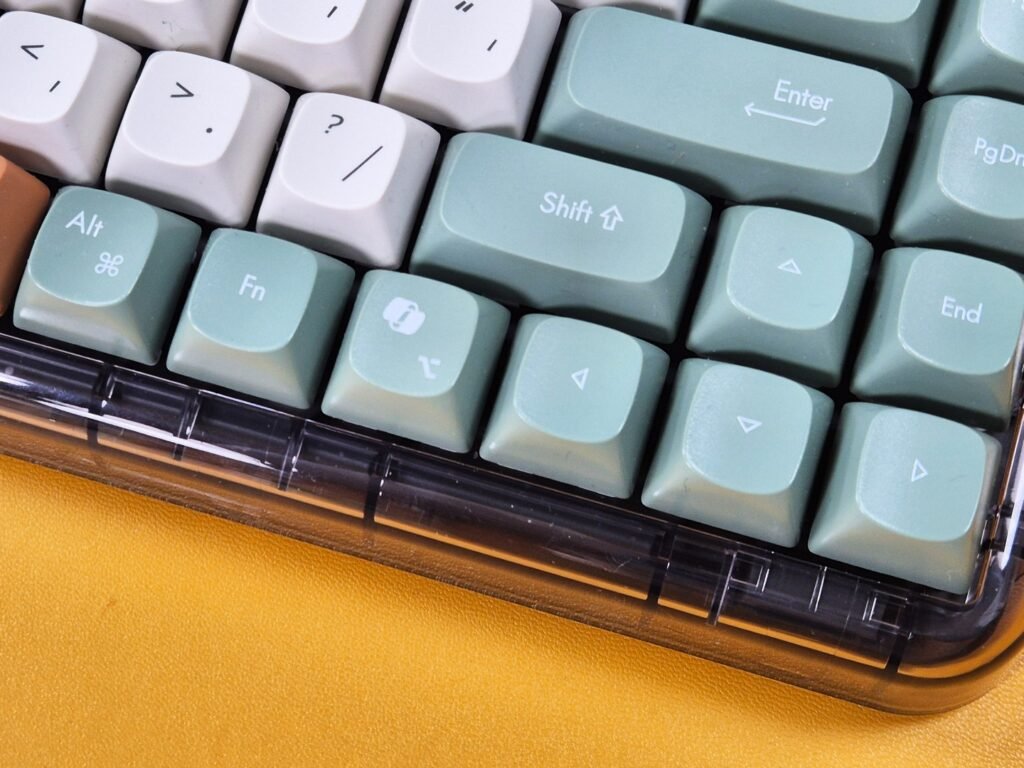
The standout feature of the Jelly75 is undoubtedly its exterior design. Available in distinct colorways like Orange Meadow and Volt Green, the keyboard features a translucent plastic body that manages to look clean rather than cluttered. You can catch glimpses of the internal structure without feeling like you have a sci-fi prop sitting on your desk.
Weighing in at roughly 1.2kg, the 75% layout board carries a reassuring heft. This heavy chassis ensures that the keyboard remains firmly planted during intensive typing sessions. ASUS also includes two different sizes of kickstands, allowing users to fine-tune the typing angle to match their ergonomic preferences.
The Typing Experience
Where the Jelly75 truly justifies its price tag is beneath the keycaps. Equipped with smooth linear mechanical switches offering 4mm of travel, the board feels remarkably quiet and fluid compared to traditional clicky alternatives. The switches arrive factory pre-lubed, minimizing friction and delivering a fast, effortless keystroke with virtually no unpleasant stem wobble.
The incorporation of a gasket mount further elevates the experience. Rather than the harsh bottom-out feel characteristic of rigid, tray-mounted boards, the Jelly75 offers a slight, pleasant flex that dampens impact and cushions long hours of typing. Stabilizers on the larger keys perform admirably, keeping keys balanced, though the spacebar carries a slightly distinct acoustic profile compared to the alphanumeric cluster.
For tinkerers, the board is fully hot-swappable, meaning you can easily swap out switches down the line without needing a soldering iron. However, ASUS made a puzzling omission by failing to include a keycap or switch puller in the box, requiring buyers to source their own tools if they plan on customizing.
Connectivity and Battery Endurance
Versatility is another major asset. The Jelly75 supports a tri-mode connection setup: wired, Bluetooth, and 2.4GHz wireless via an included USB dongle. Switching between multiple paired devices—such as a work laptop and a home desktop—is seamless and quick.
Battery performance is nothing short of phenomenal. Powered by a 4,000mAh internal battery, ASUS rates the board for up to 8,500 hours of use with the backlight turned off. While verifying a year-long battery claim requires long-term testing, the endurance proves robust enough that recharging is rarely a concern. The only minor ergonomic oversight is the lack of a dedicated storage slot for the 2.4GHz wireless dongle, meaning you will need to keep a close eye on it if you travel frequently.
Room for Improvement
No device is entirely flawless, and the Jelly75 stumbles slightly in its lighting implementation. The keyboard opts for a clean, four-level white backlight instead of RGB, which complements the minimal design philosophy. Unfortunately, the key legends themselves are not translucent. The light spills outward across the chassis rather than shining through the letters, rendering it largely useless for touch-typists working in a pitch-dark room. Furthermore, the absence of companion software means deeper macro custom៊ីzation options are limited.
The Verdict
The ASUS Jelly75 is not marketed as a cheap budget board, nor is it designed exclusively for hardcore gamers. Instead, it targets individuals who view a keyboard as both a productivity tool and a central piece of desk decor. With its robust build quality, comfortable gasket-mounted typing feel, and striking translucent aesthetic, it delivers a deeply satisfying experience right out of the box—making it a worthy investment for anyone looking to upgrade their daily workspace.
