

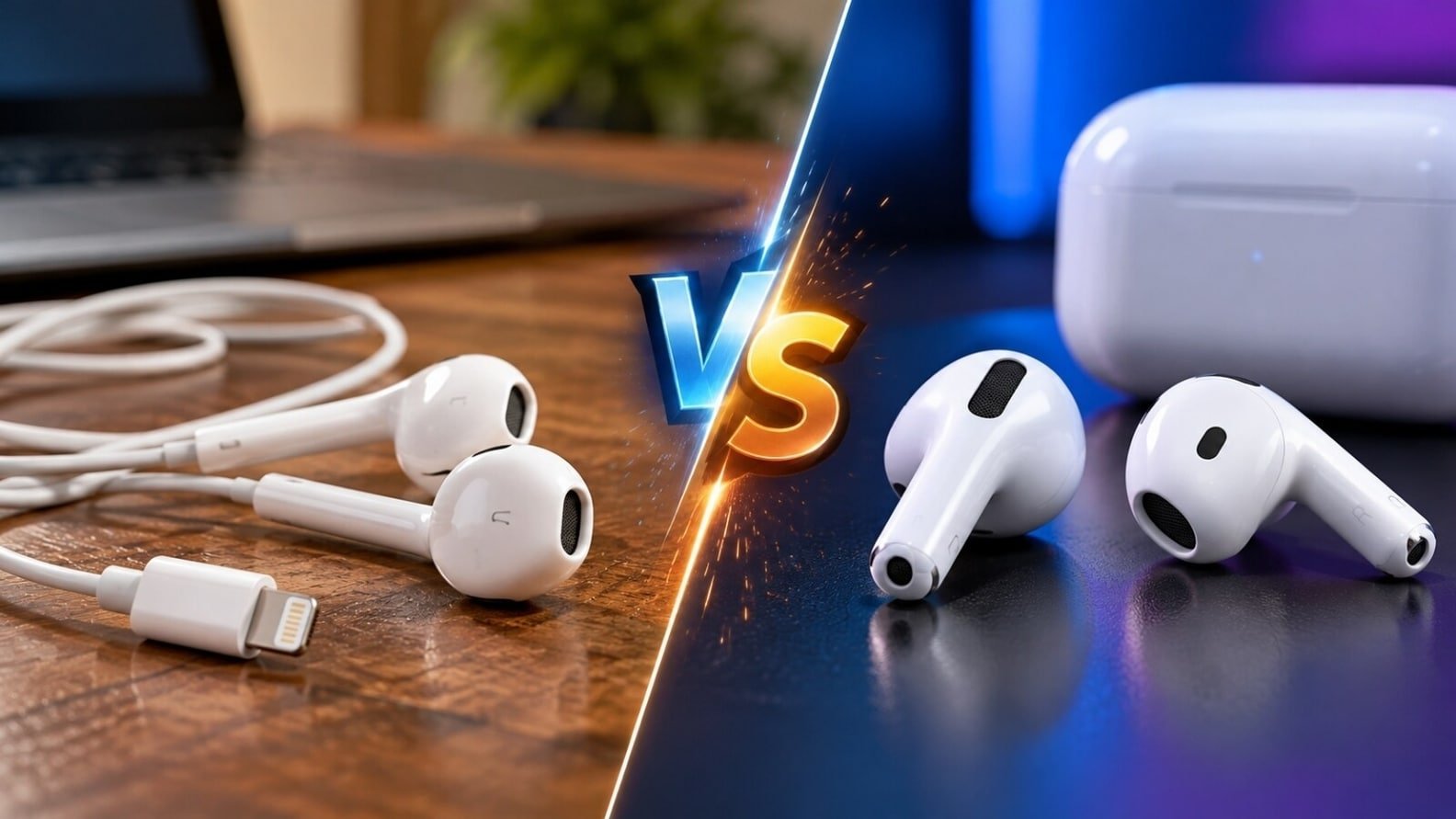
Navigating the labyrinth of audio gear during a major retail event like the Amazon Great Indian Festival presents a perennial dilemma for the discerning consumer. On one hand, eye-catching discount banners lure shoppers toward sleek, feature-packed wireless earbuds that promise untethered freedom. On the other hand, a humble, understated array of wired options beckons, offering incredible acoustic value at a fraction of the cost.
While manufacturers and marketing campaigns heavily tilt toward the wireless revolution, a substantial segment of users eventually finds themselves reverting to the reliability of a physical cable. To make a confident investment during the ongoing sale, it is essential to look beyond the promotional pricing and analyze how wired and wireless earphones fundamentally alter your daily listening experience across sound fidelity, battery autonomy, call clarity, latency, and long-term durability.
Comprehensive Feature Comparison Matrix
Sound Quality: Unpacking the Acoustic Equation
From an engineering standpoint, wired earphones maintain an intrinsic architectural advantage. A copper or silver-plated cable carries an uncompressed analog audio signal directly from the source to the acoustic driver, preserving every subtle nuance of the master recording.
Conversely, wireless earphones must rely on a digital Bluetooth pipeline. This process requires compressing the audio data via specific codecs—such as SBC, AAC, aptX, or LDHC—before transmitting it through the airwaves, where it is subsequently unpacked and converted back into an analog signal by a tiny internal amplifier and DAC. While advanced high-bitrate codecs narrow this gap significantly, achieving true lossless reproduction wirelessly requires specialized hardware compatibility between both your playback device and your earbuds.
For casual listening during a noisy commute, the compression artifacts of a good wireless pair are largely imperceptible. However, for critical listening sessions featuring high-resolution lossless tracks, or for users seeking maximum acoustic fidelity per rupee spent, a well-tuned wired pair or In-Ear Monitor (IEM) remains unequivocally superior.
Best Wired Earphones to Buy During the Sale
For audiophiles, budget-conscious purists, and desktop users seeking uncompromising sound quality, several standout wired options are heavily discounted during the festival:
-
Sennheiser IE 200 In-Ear Audiophile Headphones
-
Sale Price: ₹7,990 (MRP: ₹14,990 | 47% OFF)
-
Highlights: Renowned German acoustic engineering featuring a 7mm wide-band dynamic driver, detachable MMCX cables, flexible ear hooks, and a balanced tuning profile delivering rich bass with exceptional clarity.
-
-
Apple EarPods (USB-C)
-
Highlights: A seamless, affordable plug-and-play solution optimized for modern USB-C smartphones and tablets, offering comfortable ergonomics and a built-in remote with a high-clarity microphone.
-
-
Concept Kart KZ EDX Pro IEM Earphone
-
Highlights: An entry-level favorite featuring special dual-magnetic circuit dynamic drivers encased in a striking resin-inlay metal housing, paired with a detachable 5N OFC 2-pin cable and integrated microphone.
-
-
Amazon Basics Pro Series IEM Earphone
-
Highlights: Tailored for musicians and enthusiasts, boasting a 3.5mm plug, dual-magnetic circuit dynamic drivers, a durable metal body, and a detachable oxygen-free copper (OFC) cable.
-
-
realme Buds 3 Wired in-Ear Earphones
-
Highlights: Equipped with 9mm bass boost drivers, a tangle-free braided cable, a standard 3.5mm audio jack, and a tactile one-button remote.
-
Convenience, Movement, and Everyday Portability
The primary driving force behind the widespread adoption of wireless earbuds is ergonomics. Eliminating the physical tether removes the constant annoyance of cables snagging on door handles, twisting into complex knots inside pockets, or tugging awkwardly on your ears when you turn your head.
For activities like running, weightlifting, or multitasking around the house while your phone sits on a desk, wireless earbuds offer a liberating user experience that is difficult to abandon once experienced. Furthermore, managing quick phone calls while carrying groceries or walking through busy environments is effortless when you can simply tap an earbud.
Wired earphones operate on an entirely different philosophy: absolute friction-free simplicity. There is no pairing protocol to troubleshoot, no companion smartphone app to update, and zero anxiety over whether your listening gear has enough battery percentage to get through the afternoon. They are plug-and-play tools designed for reliable, uninterrupted productivity.
Best Wireless Earphones to Buy During the Sale
If your routine demands untethered mobility, active noise cancellation, and seamless smart features, the sale features compelling wireless contenders:
-
Apple AirPods (Latest Generation)
-
Highlights: Deep integration with the Apple ecosystem, offering effortless device switching, spatial audio capabilities, and a refined ergonomic fit.
-
-
Sony WF-C510 Wireless Bluetooth Earbuds
-
Highlights: Compact and lightweight design featuring Ambient Sound Mode, IPX4 water resistance, quick-charge technology, multipoint connectivity, and up to 22 hours of total battery life.
-
-
Oppo Enco Air 5 True Wireless Earbuds
-
Highlights: Advanced real-time active noise cancellation (up to 52dB), an impressive 54-hour total playtime, triple-mic AI clear call technology, low-latency performance, and fast charging.
-
-
OnePlus Bullets Wireless Z2 ANC Bluetooth Earphones
-
Highlights: A neckband-style wireless option featuring 45dB hybrid ANC, punchy 12.4mm bass drivers, and rapid charging that delivers hours of playback from a quick 10-minute top-up.
-
-
realme Buds Air 8
-
Highlights: Dual dynamic bass drivers (11mm + 6mm), robust 55dB ANC, a 6-mic environmental noise cancellation array, ultra-low 45ms latency mode, 360-degree spatial audio, and Hi-Res LHDC support.
-
Battery Autonomy and Power Management
One of the most overlooked hidden costs of transitioning entirely to wireless audio is power management. A wired pair of earphones demands zero electrical maintenance, operating indefinitely as long as the physical connection remains intact.
Wireless earbuds, by contrast, are governed by the laws of battery chemistry. Individual earbuds typically offer anywhere from 4 to 8 hours of continuous playback, supplemented by multiple charges housed within the charging case. While this suffices for most standard daily workflows, forgetting to dock your case before embarking on a long-haul flight or an extended commute leaves you stranded in silence.
Moreover, power user ecosystems already require charging smartphones, smartwatches, laptops, and tablets. Adding yet another battery-powered accessory to your daily charging routine introduces cumulative device fatigue. While modern rapid-charging technologies can restore an hour of listening time from a brief 10-minute stint in the case, the fundamental tether to a power outlet remains.
Signal Latency in Gaming and Media Consumption
Latency refers to the temporal delay between an event occurring within your digital media source—such as a gunshot in a competitive tactical shooter or a lip movement in a film—and the corresponding audio wave reaching your eardrum.
Standard Bluetooth audio streaming protocols inherently introduce a measurable propagation delay ranging from 150 to 300 milliseconds. While perfectly tolerable for music playback and casual video streaming (where playback algorithms automatically sync audio and video tracks), this lag becomes glaringly obvious in competitive mobile gaming or real-time audio monitoring.
While many modern wireless earbuds incorporate dedicated “Low Latency” or “Gaming Modes” that compress packet sizes and optimize transmission speeds, wired earphones remain undefeated in this arena. Because data travels via direct electrical impulses over copper wiring, latency is effectively zero, making wired configurations the undisputed choice for esports enthusiasts and audio professionals.
Call Clarity, Microphones, and Active Noise Cancellation (ANC)
Environmental adaptability is another domain where wireless technology shines. Active Noise Cancellation leverages outward-facing and inward-facing microphones to sample ambient environmental noise and generate inverse sound waves that neutralize low-frequency drones, making them indispensable for frequent air travelers, open-plan office workers, and city commuters.
Furthermore, true wireless earbuds often pack sophisticated multi-microphone arrays aided by artificial intelligence algorithms (AI-ENC) to isolate your voice from background clamor during phone calls. While premium wired IEMs can offer exceptional passive noise isolation through deep ear canal seals, active electronic cancellation and advanced beamforming voice isolation are almost exclusively restricted to powered wireless form factors.
Hardware Compatibility in the Modern Smartphone Era
A practical hurdle facing prospective wired earphone buyers is the gradual extinction of the traditional 3.5mm analog headphone jack across contemporary smartphones and tablets. Relying on a wired connection often requires purchasing a dedicated USB-C to 3.5mm Digital-to-Analog Converter (DAC) dongle or specifically sourcing USB-C terminated wired earphones.
Wireless earbuds bypass hardware compatibility issues entirely, interfacing seamlessly with any Bluetooth-enabled host device across iOS, Android, Windows, and macOS without requiring physical adapters.
Durability, Degradation, and Long-Term Value
Examining the long-term economics of your purchase reveals divergent failure trajectories. Wired earphones typically fail due to physical stress—most commonly cable fraying near the jack or earbud stem. However, because budget and mid-tier wired options are inexpensive, replacing a damaged pair exerts minimal financial strain. Furthermore, models featuring detachable cables (such as MMCX or 2-pin IEMs) allow you to replace just the wire rather than discarding the entire unit.
Wireless earbuds face a more insidious adversary: chemical battery degradation. The microscopic lithium-ion cells packed inside compact wireless earbuds and charging cases experience capacity loss over successive charge cycles. After two to three years of daily usage, a wireless pair that once held six hours of charge may struggle to maintain two, and because these tiny cells are hermetically sealed and glued shut, end-user battery replacement is virtually impossible. Consequently, wireless earbuds must be viewed as consumable electronics with a finite operational lifespan rather than permanent audio investments.
Strategic Verdict: Which Should You Buy?
Ultimately, the choice between wired and wireless audio during the Amazon Great Indian Festival should be dictated by your specific daily routine rather than the magnitude of a discount banner:
-
Opt for Wireless If: Your day involves constant movement, gym workouts, frequent voice calls, travel, or working in loud environments where Active Noise Cancellation and unhindered freedom of movement dramatically enhance your quality of life.
-
Opt for Wired If: Your primary goals are maximizing acoustic fidelity per rupee, engaging in latency-sensitive gaming, setting up a permanent desk workstation, or enjoying absolute peace of mind knowing your gear requires zero charging cycles and boasts long-term mechanical reliability.
Many seasoned audio enthusiasts ultimately adopt a hybrid strategy: a premium wireless pair for mobile convenience and commuting, supplemented by an affordable, high-fidelity wired IEM or headset for stationary desktop use and gaming. Assess your daily habits honestly, align your purchase with your actual routine, and select the tool that serves your lifestyle best.
