

As high-level delegations from Tehran and Washington converge on Islamabad for a pivotal ceasefire summit, Iranian Parliament Speaker Mohammad Bagher Ghalibaf has signaled that Iran’s approach to the negotiations will be rooted in grievance and a deep distrust of U.S. diplomacy.
The ‘Companions’ on the Flight
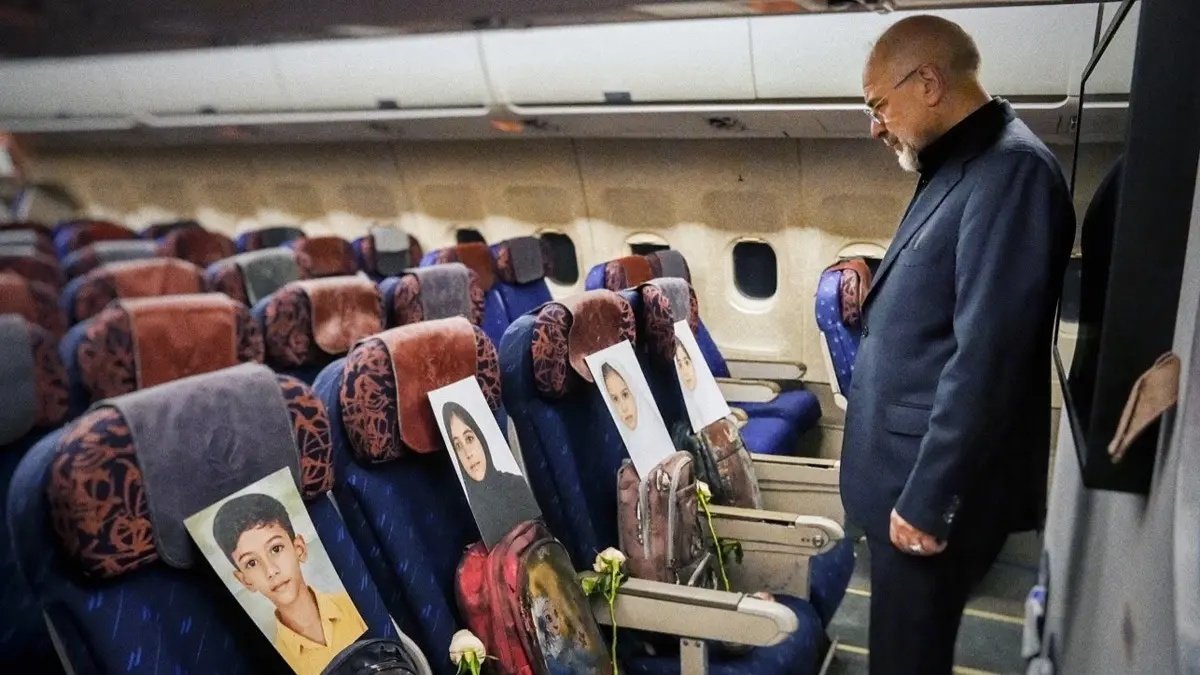
On his flight to Pakistan, Ghalibaf posted a poignant and politically charged photograph from the cabin of his aircraft. The image shows Ghalibaf and Foreign Minister Abbas Araghchi standing among empty seats, each occupied by:
-
Photos of schoolchildren killed during a missile strike on a school in Minab at the onset of the current conflict.
-
School bags and flowers, serving as a grim memorial.
-
The Message: By referring to the 165 victims as his “companions,” Ghalibaf is framing the Islamabad talks not as a standard diplomatic meeting, but as a confrontation over what Iran terms “American-led war crimes.”
The Minab Strike: A Point of Contention
The strike on the Minab school remains the most significant flashpoint of the conflict’s early stages.
-
Iran’s Stance: Tehran alleges the strike was a direct U.S. action and uses it as proof that they were “pushed” into a war of self-defense.
-
U.S. Stance: Washington has consistently distanced itself from the incident, attributing it to the fog of war or misfires, though the event remains a central pillar of Iran’s “battle of optics.”
“Goodwill, but No Trust”
Upon landing in Islamabad, Ghalibaf struck a skeptical tone regarding the success of the talks. He pointed to a history of “broken promises,” specifically alleging that the U.S. has targeted Iranian interests even while previous negotiations were active.
“Our experience of negotiations with the Americans has always been marked by failure… We have goodwill, but no trust.” — Mohammad Bagher Ghalibaf
Tehran’s Preconditions for Progress
Iran has sent a heavyweight delegation, including the Governor of the Central Bank and the Secretary of the Defense Council, indicating that financial and security issues are at the forefront. However, they have laid out two non-negotiable demands before substantial talks can proceed:
-
Ceasefire in Lebanon: A cessation of hostilities affecting Iran’s regional allies.
-
Release of Blocked Assets: The unfreezing of billions in Iranian funds currently held in international banks due to U.S. sanctions.
The Islamabad Summit: Attendees at a Glance
| Delegation | Key Representatives | Primary Focus |
| Iran | Ghalibaf (Speaker), Araghchi (FM), Hemmati (Central Bank) | Sanctions relief, Minab reparations, Lebanon ceasefire. |
| USA | High-level State & NSC officials | Regional de-escalation, maritime security, nuclear guardrails. |
| Host | Pakistani Diplomatic Corp | Mediating a durable peace framework. |
As the “Street” watches for signs of a permanent peace—which has already fueled a significant market rally in India—the opening salvos from the Iranian delegation suggest that the road to a final agreement will be paved with difficult historical reckonings and high-stakes demands.
