

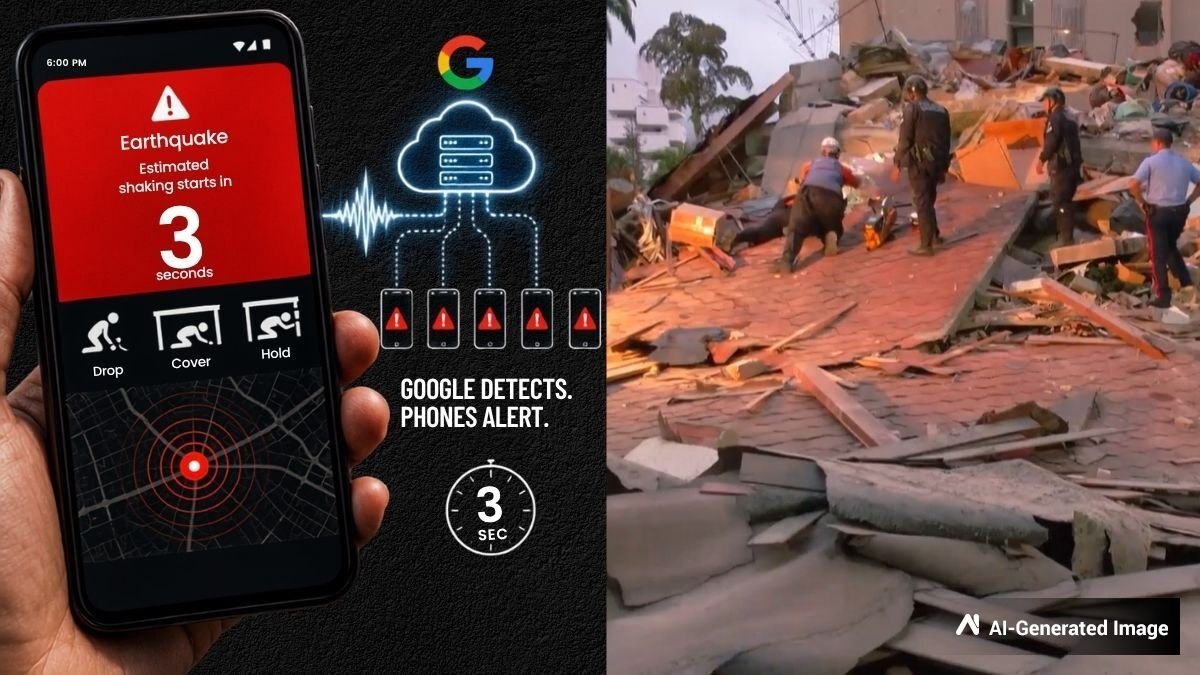
When earthquakes struck Venezuela on Wednesday evening, millions of citizens unknowingly carried pocket-sized seismometers. Google officials confirmed that its Android Earthquake Alerts System successfully detected the initial seismic activity, sending crucial warning notifications to users seconds before the tremors actually hit.
Because electronic signals travel faster than seismic waves, these brief warnings give people the critical seconds needed to drop, cover, and hold on.
How Your Phone Detects an Earthquake
The Android network operates globally across 98 countries using two distinct detection methods:
-
Official Ground Sensors (US Only): In California, Oregon, and Washington, Google partners with the US ShakeAlert system, utilizing a network of 1,675 physical ground sensors to pinpoint a quake’s size and location.
-
Crowdsourced Smartphones (Global): Everywhere else, the system relies on the tiny accelerometers built into almost all modern Android phones. When thousands of phones in the same area detect a specific vibrational pattern simultaneously, they ping Google’s detection server with an approximate location. The server aggregates this data instantly, turning millions of phones into a giant, makeshift seismic network.
Two Tiers of Warnings
Alerts are only triggered for earthquakes measuring a magnitude of 4.5 or higher. Depending on your proximity to the epicenter and the projected intensity, the system issues one of two alerts:
| Alert Type | Expected Shaking | Phone Behavior |
| “Be Aware” | Weak to Light | Behaves like a standard notification; respects your volume and “Do Not Disturb” settings. |
| “Take Action” | Moderate to Extreme | Overrides all phone settings, lights up the screen, and plays a loud, attention-grabbing sound. |
Note: Tapping either alert immediately opens an instructional map detailing safety steps and the earthquake’s estimated epicenter.
Proven Efficacy: Real-World Performance
This supplemental warning system has expanded massively since its initial 2020 US rollout, proving its worth in major seismic events worldwide.
-
The Philippines (November 2023): Following a 6.7-magnitude quake, Android sent out an alert just 18.3 seconds after tremors began. Users closest to the epicenter got up to 15 seconds of warning, while those further out received up to a full minute. In total, 2.5 million people were alerted.
-
The Science Validates It: A landmark peer-reviewed study published in the journal Science (July 17, 2025) analyzed three years of the system’s data. Led by seismologist Richard M. Allen and Google researchers, the study found the network detects an average of 312 earthquakes a month worldwide.
User Feedback from the Study:
Of the users surveyed who received an alert and felt the tremor:
36% received the alert before shaking started.
28% received it during the shaking.
23% received it after the tremors began.
While it does not replace official government seismic infrastructure, the Android network provides an invaluable, lifesaving safety net for regions lacking dedicated ground sensor networks.
