

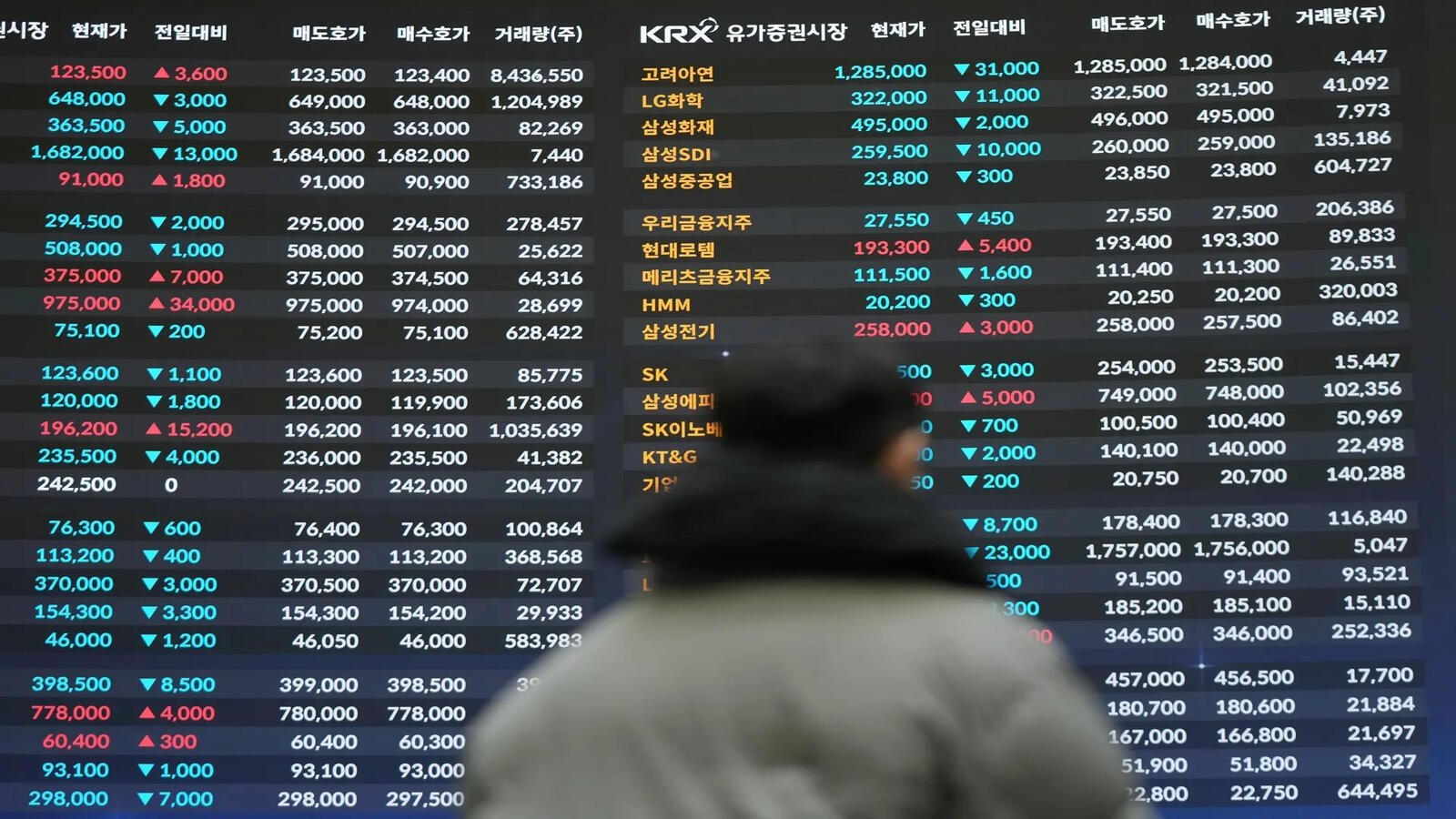
Global markets were sent a stark warning after South Korea’s benchmark KOSPI index plummeted more than 8% shortly after the opening bell, triggering an automatic 20-minute Phase 1 circuit breaker. The massive tech-led liquidation forced the Korea Exchange to temporarily halt all stock, futures, and options trading in a bid to stem widespread panic selling.
This historic market meltdown marks a pivotal moment for global tech investments, raising a critical question: Is the highly crowded AI trade finally starting to crack?
The Anatomy of the Crash: Where it Broke First
Because South Korea is home to the world’s premier memory-chip producers, the index functions less like a traditional national benchmark and more like a high-beta proxy for global AI and hardware valuations. When Wall Street turned cold on tech, Seoul became the primary global shock absorber.
| Market Asset | Trading Signal & Impact |
| KOSPI Spot Index | Plunged 8.37% intraday, crossing the country’s formal Phase 1 halt threshold. |
| Samsung Electronics | Fell 8.51%, dragging down the index as the nation’s largest chipmaker. |
| SK Hynix | Tumbled 7.29%, as highly leveraged AI memory exposure faced aggressive liquidation. |
| KOSPI 200 Futures | Dropped over 6.2%, triggering automated sell-side “sidecars” and driving mechanical selling. |
| South Korean Won | Weakened sharply near a 17-year low of 1,560 per US dollar as foreign capital exited. |
Three Shocks That Triggered the Meltdown
The collapse wasn’t a slow burn; it was a perfect storm of three distinct macroeconomic and geopolitical pressures colliding within a 72-hour window:
-
The Broadcom AI Guidance Shock: While Broadcom beat its fiscal Q2 expectations, it failed to raise its full-year AI semiconductor forecast. This missed expectation shook a market accustomed to massive “beat-and-raise” cycles, causing the Philadelphia Semiconductor Index to drop 10.3% in a single Wall Street session and setting up Asian chipmakers for a brutal Monday.
-
US Interest Rate Fears Revived: A stronger-than-expected US jobs report rattled macro investors. The robust labor data triggered fears that the US Federal Reserve will keep interest rates higher for longer—or potentially hike them further—increasing borrowing costs for capital-intensive tech firms and lowering long-duration AI growth valuations.
-
Geopolitical Escalation in the Middle East: Over the weekend, direct missile exchanges between Iran and Israel caused a massive wave of global risk aversion. As Brent crude oil surged past $93 a barrel, threatening to spark a new wave of wholesale inflation (WPI), global funds rapidly dumped equities to seek refuge in safe-haven assets.
The Bigger Picture: Structural Break or Deleveraging Event?
The extreme severity of the drop highlights a deeper structural vulnerability in South Korea’s market: Index Concentration. Samsung Electronics and SK Hynix together account for nearly half of the KOSPI’s total market value. When global fund managers decide to prune their semiconductor and artificial intelligence exposure in Asia, these two liquid stocks become the fastest exits.
While the KOSPI managed to claw back a portion of its intraday losses to sit down roughly 5-6% by midday, the event exposes the underlying fragility of an AI market that has spent the year pricing in absolute perfection.
