

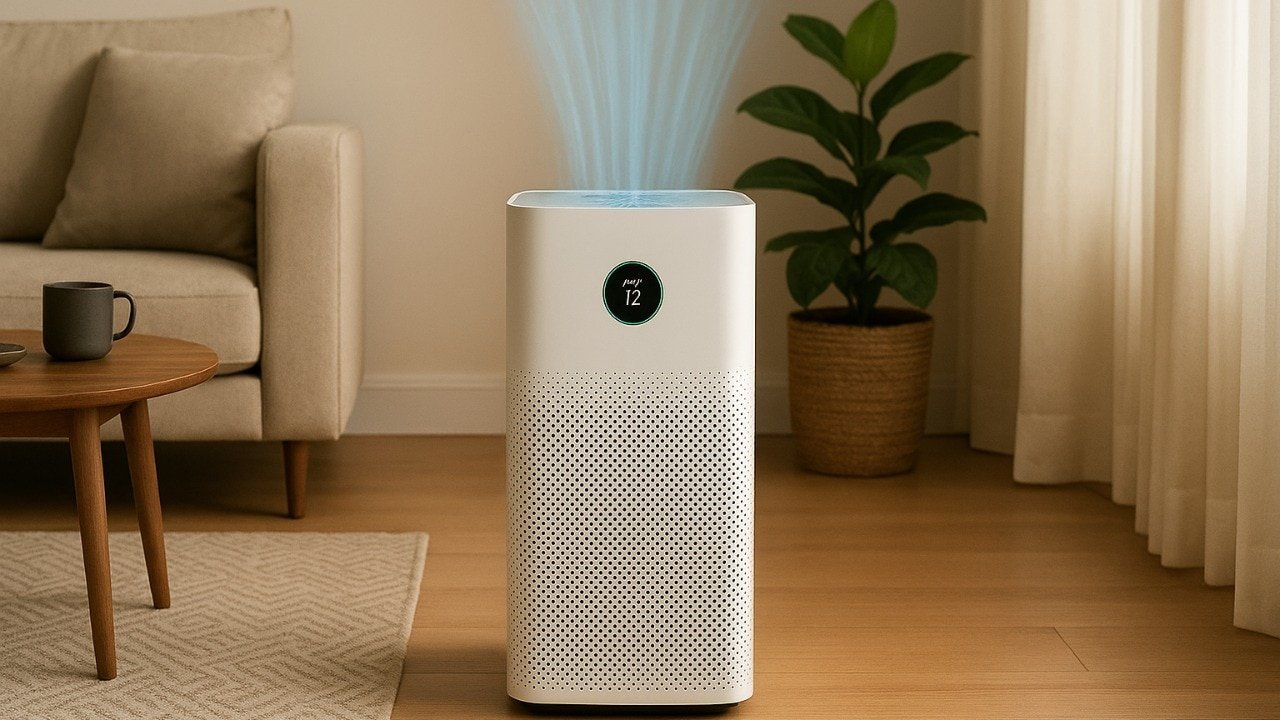
As seasonal smog descends across Delhi-NCR and northern India, deteriorating air quality brings a host of health challenges—from persistent coughs and eye irritation to severe respiratory discomfort. While sealing windows and doors is a common reaction, indoor air quality often remains compromised. Outdoor pollutants leak inside, combining with everyday indoor sources like cooking fumes, pet dander, and household dust.
To combat this, an air purifier can serve as a vital line of defense. By deploying multi-stage filtration—including high-efficiency HEPA filters—these devices effectively trap fine particulate matter ($\text{PM}_{2.5}$ and $\text{PM}_{10}$) and common allergens.
5 Reasons to Invest in an Air Purifier
-
Captures Fine Particulate Matter ($\text{PM}_{2.5}$): High-grade HEPA filters capture microscopic particles that seep into homes during peak pollution seasons.
-
Reduces Indoor Allergens: Helps alleviate seasonal and year-round allergy triggers by filtering out floating dust, pollen, and microscopic debris.
-
Protects High-Exposure Homes: Crucial for residences near high-traffic roads, busy intersections, or ongoing construction sites.
-
Eliminates Odors and Gases: Integrated activated carbon filters adsorb cooking smells, pet odors, and volatile organic compounds (VOCs).
-
Manages Pet Dander: Efficiently traps airborne pet hair and fine dander, keeping shared spaces cleaner and more comfortable.
Key Buying Considerations
-
Filter Types: Look for models with a pre-filter (for large debris), an H13 True HEPA filter (for capturing $99.97\%$ or more of fine particles down to $0.3$ microns), and an activated carbon filter (for odors/gases).
-
Clean Air Delivery Rate (CADR): Measures how rapidly the unit cleans the air. Higher CADR values indicate faster purification.
-
Room Coverage: Ensure the device’s rated coverage area matches or exceeds the room where it will be placed.
-
Filter Maintenance Costs: Factor in the long-term cost, lifespan (e.g., $9,000$ hours vs. multi-year filters), and local availability of replacement filters.
-
Smart Monitoring: Features like real-time AQI displays, auto-fan adjustment based on laser particle sensors, and app/voice controls add significant convenience.
Top Air Purifier Recommendations
| Model | Coverage | CADR | Key Highlights | Price Range |
| Dyson HushJet Compact (HJ10) | Up to $1,076\text{ sq ft}$ | N/A | $360^\circ$ Electrostatic filter with up to 5-year life; whisper-quiet; premium build & app support. | ₹29,900 |
| Xiaomi Smart Air Purifier 4 Lite | Up to $462\text{ sq ft}$ | $360\text{ m}^3/\text{h}$ | Triple-layer filtration; real-time AQI display; smart app and voice assistant integration. | ₹10,990 |
| Philips AC0920 Smart Purifier | Up to $320\text{ sq ft}$ | $250\text{ m}^3/\text{h}$ | NanoProtect HEPA filter; ideal for bedrooms; removes particles down to $0.003$ microns. | ₹8,999 |
| Shark NeverChange HP300 | Up to $1,400\text{ sq ft}$ | N/A | 5-Year NeverChange True HEPA 14 filter; Clean Sense IQ auto-adjustment; odor neutralizer. | ₹28,999 |
| Honeywell Air Touch V5 | Up to $589\text{ sq ft}$ | $380\text{ m}^3/\text{h}$ | 4-stage filtration (H13 HEPA + Anti-bacterial layer); WiFi connectivity; high CADR value. | ₹11,489 |
Product Overview & Standout Features
1. Dyson HushJet Purifier Compact (HJ10)
-
Best For: Large living spaces requiring quiet operation and long filter longevity.
-
Key Features: Combines a 360° electrostatic filter with activated carbon. Automatically monitors AQI and offers seamless MyDyson app integration.
-
Pros: Exceptionally low noise, premium design, long filter lifespan (up to 5 years).
-
Cons: Higher initial price point.
2. Xiaomi Smart Air Purifier 4 Lite
-
Best For: Budget-conscious users seeking strong smart feature integration.
-
Key Features: 3-stage filtration with True HEPA, real-time LED AQI monitor, and support for Google Assistant and Alexa.
-
Pros: Excellent value for money, quiet performance, high CADR for its class.
-
Cons: Best suited for medium-sized rooms.
3. Philips AC0920 Smart Air Purifier
-
Best For: Bedrooms and compact living areas.
-
Key Features: NanoProtect HEPA filtration designed to capture ultra-fine particles and viruses down to $0.003$ microns; up to $9,000$ hours of filter life.
-
Pros: Compact footprint, whisper-quiet sleep mode, highly sensitive AQI sensors.
-
Cons: Limited effective range in very large open spaces.
4. Shark NeverChange HP300
-
Best For: Large, open-plan spaces and low-maintenance preferences.
-
Key Features: HEPA 14 filter rated for up to 5 years, Clean Sense IQ for real-time auto-adjustment across $\text{PM}_{1.0}$, $\text{PM}_{2.5}$, and $\text{PM}_{10}$.
-
Pros: Massive coverage area ($1,400\text{ sq ft}$), integrated odor neutralizer, long-lasting filter.
-
Cons: Higher upfront cost.
5. Honeywell Air Touch V5
-
Best For: Comprehensive multi-layer protection in medium-to-large spaces.
-
Key Features: 4-stage system including a Nano-Silver anti-bacterial layer and H13 HEPA filter, removing up to $99.99\%$ of fine particles.
-
Pros: High CADR ($380\text{ m}^3/\text{h}$), Wi-Fi and voice control, competitive pricing.
-
Cons: Air quality indicator LED can occasionally be sensitive or tricky to read at a glance.
