

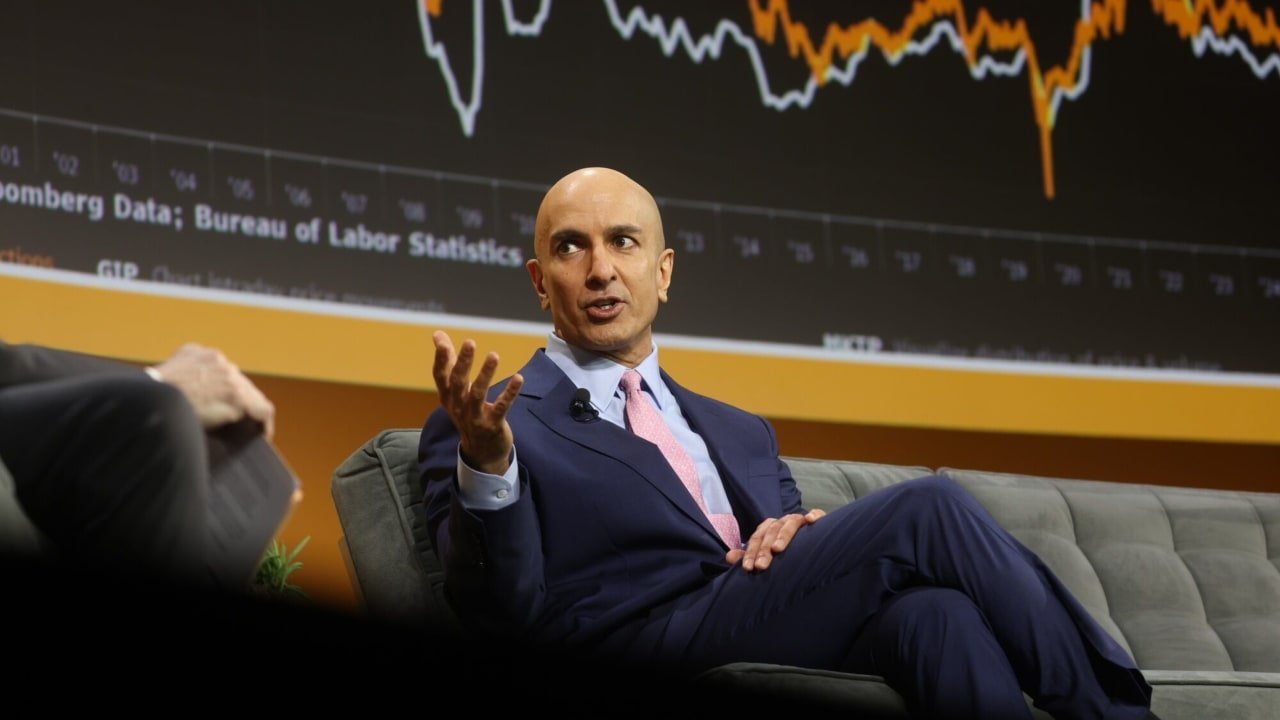
In a significant break from the Federal Reserve’s recent “easing bias,” Minneapolis Fed President Neel Kashkari stated on Friday, May 1, 2026, that the central bank must acknowledge the possibility of future interest rate hikes. His comments came as he explained his dissent from this week’s FOMC decision to maintain the current “forward guidance” which implies that the next move for rates would likely be a cut.
Kashkari was one of four dissenters at the April 2026 meeting—the highest number of dissenting votes on the committee since 1992—highlighting a deep divide within the Fed as it navigates the economic fallout of the Iran war.
The “Strait of Hormuz” Factor
Kashkari’s concerns are rooted in the “physical reality” of the energy market. With global oil prices recently touching $126 per barrel (up from $70 at the start of the conflict), the economic outlook has shifted dramatically.
-
Supply Chain Chokepoint: Tehran’s virtual blockade of the Strait of Hormuz has paralyzed a primary artery for global energy and fertilizer shipments.
-
Persistent Inflation: Kashkari noted that even in a “benign scenario” where the waterway reopens soon, underlying U.S. inflation is expected to remain at 3%—well above the Fed’s 2% target.
-
The Risk of Unanchoring: If the price shock wave is larger or longer than expected, Kashkari fears long-term inflation expectations could become “unanchored,” requiring a “strong policy response.”
Key Takeaways from the Dissent
-
End the “Easing Bias”: Kashkari argues the Fed should stop signaling that a rate cut is the next likely step. Instead, the policy outlook should explicitly state that the next move could be either a cut or a hike.
-
Potential for a “Series” of Hikes: He warned that a series of interest rate increases may be warranted to defend the Fed’s credibility, even at the risk of causing “further weakness to the labor market.”
-
Divided Committee: While Kashkari, Beth Hammack (Cleveland Fed), and Lorie Logan (Dallas Fed) dissented against the easing bias, Governor Stephen Miran dissented in favor of an immediate 25-basis-point cut, illustrating the extreme uncertainty among policymakers.
Market Impact: A “Hawkish” Reality Check
Kashkari’s warnings have injected a dose of caution into a market that had been rallying on “historic” semiconductor growth. For investors, the takeaway is clear:
-
Bond Yields: The possibility of rate hikes rather than cuts could keep bond yields elevated for longer.
-
Sector Rotation: Capital-intensive sectors (like Spirit Airlines, currently struggling with debt) may face further pressure, while sectors with high pricing power (like Steel or Premium Auto) remain more resilient.
-
Currency Volatility: As noted by RBI Governor Malhotra, central bank policy shifts in the U.S. will continue to exert pressure on global currencies like the Rupee.
The Bottom Line: While the stock market has shown a “clean narrative” of AI-driven growth in April, Kashkari’s dissent serves as a reminder that the “wall of physical reality”—driven by oil and geopolitics—could yet force the Fed’s hand in a more aggressive direction.
