

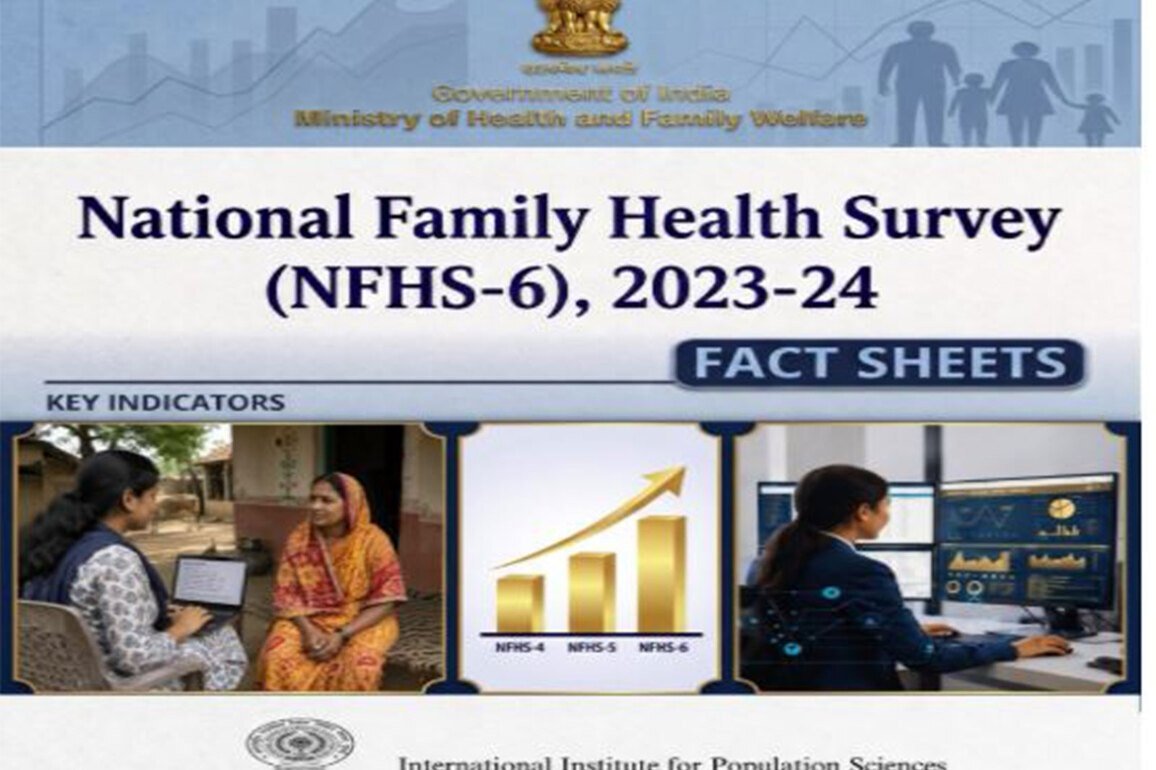
The Union Health Ministry has released the findings of the National Family Health Survey-6 (NFHS-6), revealing a massive structural expansion in India’s healthcare safety net. More than 60% of Indian households are now covered by a health insurance or financing scheme, marking a dramatic surge from the 41% baseline recorded during the NFHS-5 survey (2019–21).
Managed by the International Institute for Population Sciences (IIPS) in Mumbai, the exhaustive multi-phase study analyzed data from over 679,000 households between May 2023 and December 2024. A key takeaway from the data reveals that rural India is actively outpacing urban centers in insurance adoption, largely propelled by massive state-backed welfare initiatives like Ayushman Bharat (PM-JAY).
The Changing Landscape of Healthcare Coverage
The rapid scale-up of public insurance frameworks has re-engineered healthcare security across demographics, bringing rural populations firmly into the formal safety net:
While the expansion signals a crucial milestone toward universal health coverage, the survey highlights a parallel, deeply concerning transition: India is grappling with a severe spike in metabolic and lifestyle-driven diseases.
| Health Indicator | Women’s Metric | Men’s Metric | Urban Focus |
| Overweight / Obese | 30.7% | 27.3% | Peaks in cities: 42.8% of women and 36.3% of men |
| High Blood Sugar | 17.8% | 20.9% | Driven heavily by poor lifestyle habits and dietary shifts |
Significant Gains in Maternal and Child Health
Beyond financial coverage, NFHS-6 tracks stellar infrastructure upgrades and behavioral improvements across maternal care and early childhood immunization:
-
Stabilized Fertility: India’s total fertility rate has stabilized effectively at 2.0, right at the sub-replacement level.
-
Safer Childbirth: Institutional deliveries successfully climbed from 88.6% to 90.6%, while births supervised by skilled medical personnel improved to 91.3%. Antenatal care coverage expanded to 95.9%.
-
Nutritional Support: The percentage of expectant mothers consuming vital Iron Folic Acid (IFA) tablets for 100 days or more surged from 44.1% to 54.9%.
-
The Immunization Triumph: Overall childhood vaccination rates grew to 87.1%, with 95.6% of children receiving doses at public clinics. Notably, coverage for the Rotavirus vaccine (protecting against severe diarrhea) more than doubled—skyrocketing from 36.4% to 85.4%.
-
Malnutrition Declines: Stunting (low height-for-age) among children under five dropped from 35.5% to 29.3%, while severe wasting (acute, life-threatening undernutrition) fell from 7.7% to 5.2%.
The Stark Public-Private Delivery Divide
Despite exceptional strides across basic child survival metrics, the survey brought a glaring systemic anomaly to light regarding how children are delivered in India.
While the nationwide average for Caesarean section (C-section) deliveries stands at 27.2%, an extreme gap exists between healthcare models. C-section deliveries in private hospitals have touched a staggering 54.1%, whereas public health facilities recorded a vastly more conservative 16.9%.
This extreme variation continues to raise tough questions among medical experts regarding the commercialization of childbirth practices within private medical systems, standing out as a key area requiring policy intervention as India moves toward its broader development goals.
