

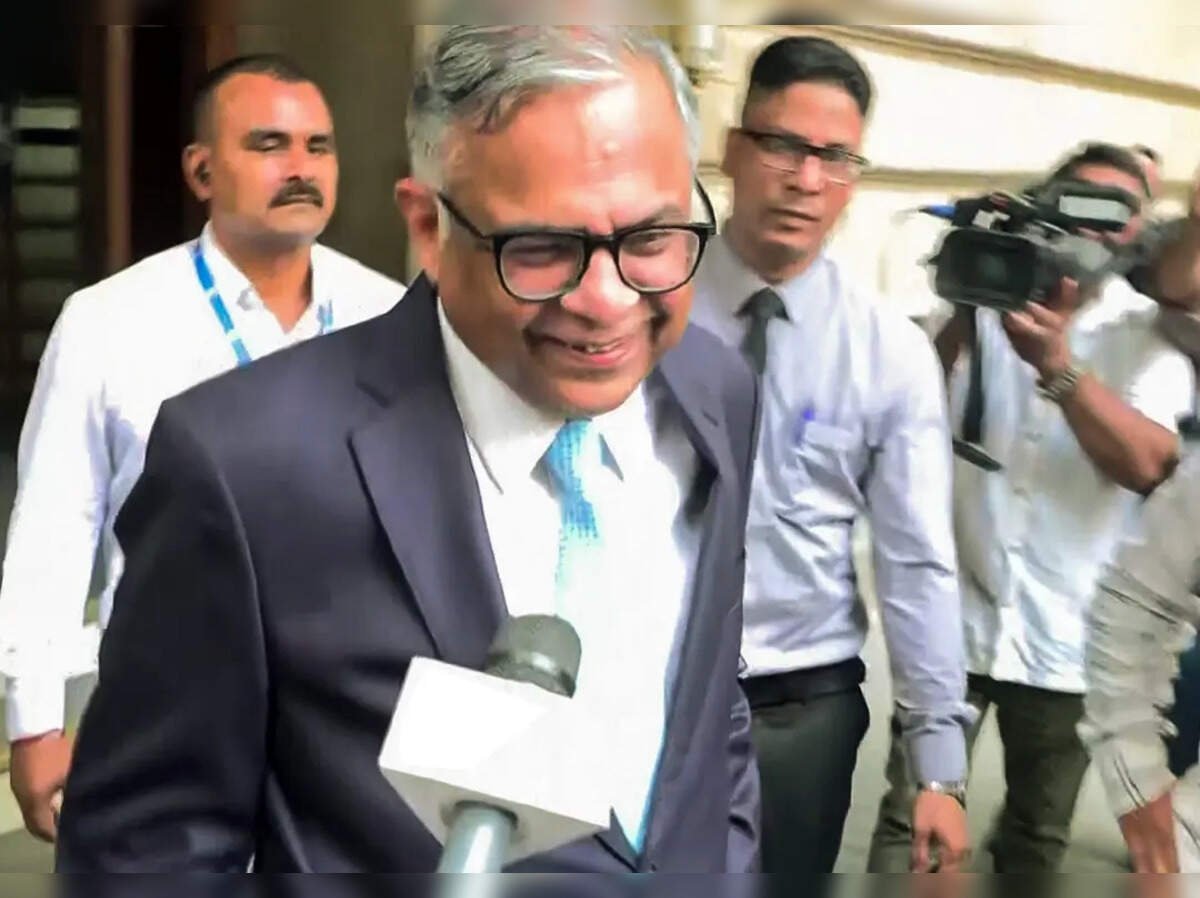
The Board of Directors of Tata Sons, the flagship holding company of the salt-to-software Tata Group, convened at its historic Bombay House headquarters on Friday. The high-profile meeting, which lasted for roughly four hours, concluded with the formal review and approval of the conglomerate’s annual financial accounts and dividend metrics for the fiscal year ended March 31, 2026.
The session saw the convergence of the top tier of Tata leadership, including Tata Sons Executive Chairman N. Chandrasekaran, newly appointed Tata Trusts Chairman Noel Tata, and Tata Trusts Vice Chairman Venu Srinivasan.
Despite the high stakes of the meeting, highly placed sources confirmed that two of the most intensely speculated topics surrounding the group were noticeably absent from the boardroom table: the extension of Chairman Chandrasekaran’s tenure and the highly contested public listing of the holding company.
The SBR Standoff: To List or Not to List?
The omission of the listing discussion comes at a critical juncture for the conglomerate. Tata Sons continues to find itself caught in a regulatory tightening of the script by the Reserve Bank of India (RBI).
Under the RBI’s Scale-Based Regulation (SBR) framework, Tata Sons is classified as an Upper-Layer Non-Banking Financial Company (NBFC-UL) due to its massive systemic importance and asset size. Under the original 2022 directive, all Upper-Layer NBFCs faced a strict three-year countdown clock to list on public stock exchanges—a deadline that technically lapsed on September 30, 2025.
While Tata Sons has cleared its standalone holding debt of over ₹22,000 crore and formally applied to surrender its Core Investment Company (CIC) registration to bypass the mandate, the RBI has kept the company on its regulated upper-layer register. The issue is expected to reach a head shortly, as RBI Governor Sanjay Malhotra recently noted that the central bank will soon release an updated, revised classification list for large NBFCs.
The Philosophical Divide: Inside Bombay House, a clear structural disagreement has emerged. While corporate advisers note an IPO would bring unprecedented transparency to group-level capital allocations, Tata Trusts Chairman Noel Tata is reportedly highly reluctant to take the core holding company public. Because Tata Trusts owns a commanding 66% majority stake in Tata Sons, Noel Tata’s conservative approach holds massive sway over the firm’s long-term structure.
Leadership Continuity Remains Formally Unaddressed
Similarly, the board did not hold formal deliberations regarding an extension for Executive Chairman N. Chandrasekaran. Chandrasekaran, who took the helm of Tata Sons in 2017 following a highly publicized leadership transition, was granted his first five-year extension in early 2022.
While market observers widely expect conversations regarding his continuation or structural transition to amplify as his current term nears its completion, the board focused its energy strictly on auditing fiscal performance, approving cross-company dividends, and assessing the performance of active subsidiaries across the sprawling multi-billion dollar empire.
