

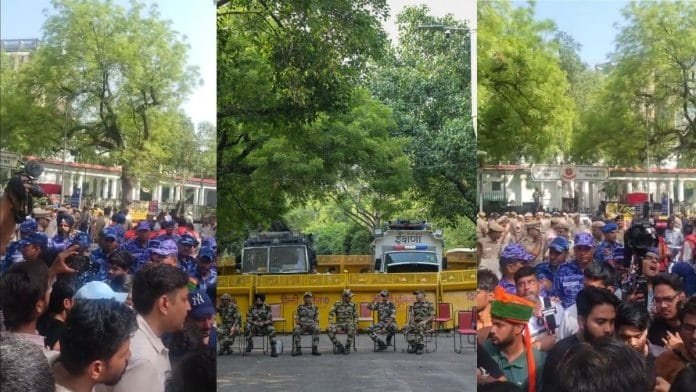
The national capital witnessed a major real-world mobilization on Saturday as thousands of students and youth gathered at Jantar Mantar in New Delhi. Led by founder Abhijeet Dipke, the Cockroach Janta Party (CJP) staged its first major offline demonstration, demanding the immediate resignation of Union Education Minister Dharmendra Pradhan over structural failures, paper leaks, and evaluation irregularities across prominent national exams.
What began in May as a satirical digital movement on social media—responding to controversial remarks comparing citizens to “cockroaches” and “parasites”—has quickly transformed into an organized campaign for institutional accountability.
The Epicenter of Unrest: Examination Inconsistencies
The sudden escalation from online commentary to a street demonstration highlights deep-seated frustration among India’s student community. Protesters at the site highlighted three distinct institutional failures:
-
The NEET-UG Paper Leak: The highly competitive medical entrance test, taken by more than 22 lakh candidates on May 3, was hit with systemic leaks, forcing a complete reschedule of the exam for June 21.
-
The CBSE Class 12 Evaluation Crisis: Growing controversies and technical flaws surrounding the On-Screen Marking (OSM) portal and evaluation tender process left thousands of board students facing irregular final results.
-
CUET Administrative Lapses: Widespread systemic mismanagement during the central university admission tests compounded anxieties for college-bound aspirants.
Dipke Returns from the US to Lead Frontline Demonstration
CJP founder Abhijeet Dipke, a political strategist, traveled from Boston in the United States to lead the movement directly. Upon arriving at New Delhi’s international airport, Dipke was met by police officials before heading straight to the demonstration site, carrying a copy of Dr. B.R. Ambedkar’s autobiography to signal his constitutional framework.
Ahead of the march, the Delhi Police issued an official order from the office of the Additional Deputy Commissioner of Police granting the CJP a one-time exemption to hold a peaceful demonstration from 10:00 AM to 5:00 PM, in line with Supreme Court guidelines. Organizers quickly routed their massive base—which includes an extensive digital network—directly to Jantar Mantar rather than staging a sit-in outside localized police stations.
Security Forces on High Alert Amid Brief Tensions
Because the online outfit commands a massive Gen-Z following across platforms like Instagram and X, authorities left nothing to chance. Delhi Police and paramilitary forces set up a multi-layered security net, deploying approximately 40 paramilitary companies across key locations in the national capital, including major transit hubs, railway stations, and city borders.
While the organizers repeatedly called for non-violent resistance, brief moments of chaos were reported around noon when security forces detained a small group of counter-demonstrators for raising provocative slogans against the CJP protesters.
Simultaneously, state police stepped up security around Dipke’s family residence in Chhatrapati Sambhajinagar, Maharashtra, to prevent localized crowding as public interest in the movement spiked nationwide.
Systemic Rot and the Demand for Accountability
The protest marks a crucial moment for the CJP as it attempts to transition its viral internet presence into an organized, real-world political phenomenon. Protesters at the venue carried signs with slogans reading “We asked for ‘Make in India’, you gave us ‘Leak in India'” and “NTA Band Karo” (Shut down the National Testing Agency).
Movement spokespersons emphasized that the protest is not merely about political satire but about establishing minimum accountability in an educational system where institutional rot has set in. With prominent climate activist and education reformer Sonam Wangchuk previously vowing solidarity, the pressure on the Ministry of Education continues to build as students look toward the upcoming rescheduled national examinations.
