

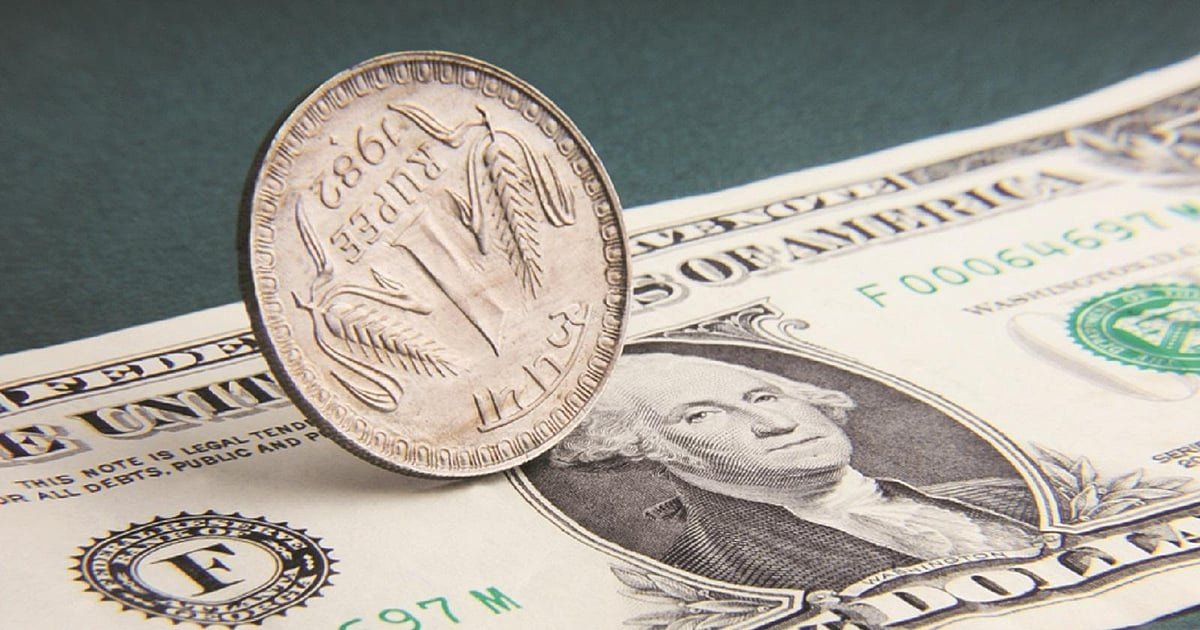
The Indian currency market witnessed a high-velocity turnaround during Thursday’s trading session. After a bruising mid-week capitulation that sent shockwaves through treasury desks, the spot rupee clawed back deep losses to trade at 96.43 against the US dollar, recovering from an early intraday low of 96.60.
The primary catalyst for this swift technical reversal was a major geopolitical macro shift: statements from US President Donald Trump indicating that highly anticipated peace negotiations with Iran are finally entering their final stages, triggering immediate cooling across global commodity benchmarks.
The Forward Market Warning Shot
While the spot market showed immediate signs of structural stability on Thursday, the real drama unfolded in the derivatives and forward booking channels just 24 hours prior:
-
The 100/USD Breach: On Wednesday, the one-year implied forward market rate for the rupee briefly breached the psychologically significant 100 per dollar milestone.
-
The Valuation Bias: Crossing this three-digit threshold signals that international currency markets are fundamentally pricing in a structural, long-term weakening bias for the USD/INR pair over the next 12 months.
-
Elevated Hedging Costs: Implied forward yields remain heavily paid across the entire curve, with 3-month, 1-year, and 3-year yields settling at 3.73%, 3.48%, and 3.44% respectively, driving up hedging costs for domestic importers.
The Geopolitical Friction: Trump vs. Netanyahu
The currency’s underlying recovery remains highly sensitive to a delicate, shifting diplomatic axis in Washington and the Middle East:
The Axios Disclosure: On Wednesday, US media outlets reported a highly tense phone call between US President Donald Trump and Israeli Prime Minister Benjamin Netanyahu. While Washington has pushed aggressively for an immediate diplomatic deal to resolve the Iran conflict and cool energy lanes, Netanyahu has reportedly argued for a resumption of targeted strikes to dismantle Iran’s critical infrastructure.
Because the domestic rupee has already shed more than 6% of its value since the initial intensification of the Iran conflict, any renewed escalation threatens to rapidly reverse Thursday’s relief gains.
Macro Headwinds and Institutional Defenses
Despite the short-term currency bounce, the broader domestic financial indicators reflect a market maintaining a highly defensive posture:
| Metric Group | Current Performance Layer | Macro Implications |
| Dollar Index (DXY) | Trading at 99.30 (+0.22%) | Relentless greenback resilience limits the rupee’s upside. |
| Brent Crude Oil | Hovering at $106.02 per barrel | Elevated import bills continue to test India’s current account deficit. |
| Domestic Equities | Sensex down 207 pts to 75,111.35 | Nifty slides to 23,638.15 amid muted local sentiment. |
| FII Capital Flows | Net outflow of ₹1,597.35 crore (Wednesday) | Persistent foreign equity capitulation drains local dollar liquidity. |
The Central Bank Firewall
To counteract the aggressive drain on liquidity caused by daily spot market defense interventions, the Reserve Bank of India (RBI) has deployed a critical secondary firewall. The central bank has lined up a massive $5 billion USD/INR buy-sell swap auction scheduled for May 26.
This multi-year, three-year tenor operation is engineered to achieve two critical goals simultaneously: it injects durable rupee liquidity back into a tightening domestic banking system while cooling hyper-inflated forward premiums without sending an overly dovish policy signal via repo rate adjustments.
The Strategic View: The rupee’s pull back from the cliff edge proves that local liquidity is hypersensitive to international energy corridors. However, with the spot pair expected to stick within a volatile 96.60–97.10 trading range in the near term, corporate treasuries are using this temporary dip past 96.50 to aggressively lock in import hedges before global headlines shift again.
