

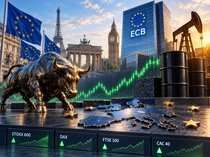
European financial markets stabilized and edged cautiously higher in early trading, attempting a tentative recovery following the region’s sharpest single-session selloff in two months. Market participants across major continental indices adopted a watchful stance, heavily balancing competing macroeconomic pressures as they awaited the highly anticipated monetary policy announcement and interest rate decision from the European Central Bank (ECB).
The pan-European STOXX 600 index registered a modest fractional gain, hovering near positive territory after absorbing heavy losses in the prior session. Across major national exchanges, performance remained tightly contained: Germany’s benchmark DAX traded near the flatline, London’s FTSE 100 inched up marginally, and France’s CAC 40 posted slightly stronger upward momentum. The fragile calm followed a tumultuous prior session where regional equities tumbled roughly 1.4%, driven primarily by macroeconomic jitters as global crude oil benchmarks breached the critical $100-a-barrel threshold.
The Macroeconomic Backdrop: Inflation and Energy Volatility
The overarching narrative dictating trading patterns remains rooted in renewed energy market volatility. Brent crude prices have firmly held above the $100 psychological ceiling, catalyzed by mounting geopolitical escalations, heightened shipping disruptions in the Middle East, and persistent regional conflicts. Concurrently, European natural-gas prices have hovered near multi-month highs, driven by dwindling inventory reserves and logistical bottlenecks.
These soaring energy metrics have re-ignited fears of persistent, structural inflation. Investors are increasingly concerned that central banks will be forced to maintain a restrictive monetary stance for an extended duration to combat price pressures. This environment has kept European government bond yields elevated near multi-year highs, reflecting a complex interplay between tightening credit conditions and underlying fiscal anxieties.
All Eyes on Frankfurt: What to Expect from the ECB
Market pricing heavily favors a widely anticipated 25-basis-point interest rate hike by the European Central Bank, marking another aggressive step in the central bank’s ongoing cycle to anchor consumer prices. However, market participants emphasize that the true catalyst for subsequent market direction will not be the rate hike itself, but rather the forward guidance and commentary provided by ECB President Christine Lagarde during her post-decision press conference.
Traders will scrutinize the central bank’s updated macroeconomic projections to gauge how policymakers plan to navigate the compounding shocks of expensive energy imports and slowing regional growth. Specifically, investors are searching for signals regarding whether the ECB intends to sustain its hawkish rhetoric into the final quarters of the year, or if policymakers will begin mapping out a plateau as economic headwinds intensify.
As global central banking calendar events loom—including upcoming monetary policy decisions from both the U.S. Federal Reserve and the Bank of Japan—European markets remain locked in a delicate holding pattern, highly sensitive to shifts in commodity prices and institutional signaling.
