

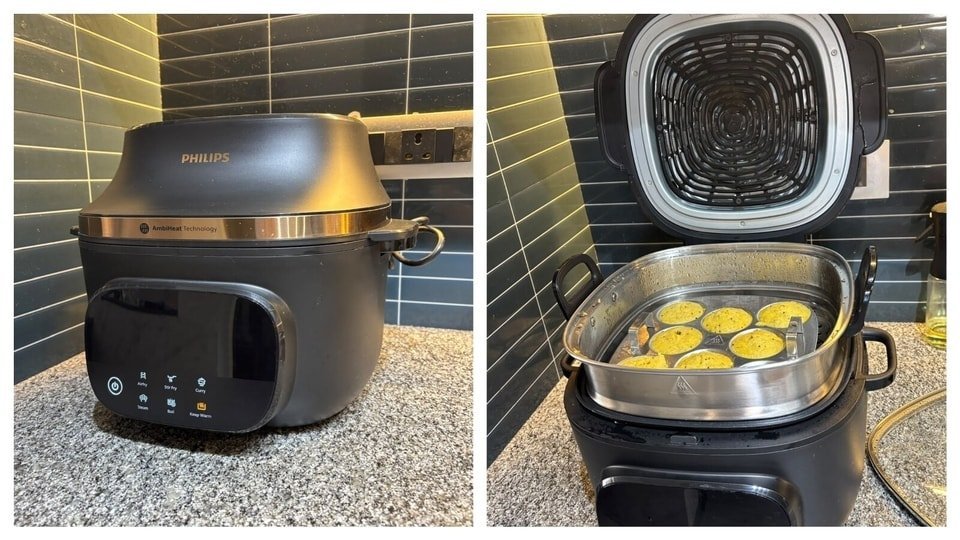
Not every kitchen experiment begins with high expectations. As someone deeply familiar with the predictability of a traditional gas stove, replacing it—even for just one meal a day—felt like an unnecessary detour. But that is exactly what I decided to do with the Philips OneChef 6L Smart All in One Device (priced at ₹19,995).
Instead of treating it like a glorified air fryer sitting on my countertop, I put it to the test with the kind of everyday Indian cooking I would normally handle over an open flame: dal, rice, aloo sabzi, idli, chicken steak, fish, and paneer tikka.
Here is what surprised me most about ditching the stove—and where the gas burner still wins.
The First Surprise: It Isn’t Just an Air Fryer
When you look at multi-function countertop appliances, it is easy to assume they are just air fryers with a few extra settings. However, the OneChef is designed to cover a much broader spectrum of cooking methods, including steaming, boiling, roasting, baking, and air frying.
Testing it with staples like steamed rice, idli, and dal changed my perception completely. It didn’t just handle high-heat grilling for chicken and paneer; it successfully integrated into standard home-cooking jobs without requiring a separate pressure cooker or steaming vessel.
Where the OneChef Beat My Gas Stove
- Hands-Off Convenience: A gas stove demands constant attention—adjusting the flame, stirring, and watching out for boil-overs. With the OneChef, once the cooking process and presets were set up, I could comfortably step away.
- Less Kitchen Clutter: By combining steaming, roasting, baking, and boiling into a single 6-litre appliance, it reduces the need to pull out multiple individual gadgets.
- Fewer Stovetop Messes: Certain preparations were noticeably cleaner and less prone to splattering compared to doing the same cooking on an open burner.
Where the Gas Stove Still Wins
Despite its versatility, the OneChef doesn’t completely render a gas stove obsolete.
- Instant Control: The immediate responsiveness of a gas flame—instantly turning it up, down, or completely off—is difficult to replicate on a digital countertop interface.
- Multi-Dish Cooking: Preparing a full Indian spread often requires multiple pans, a simultaneous tadka, and boiling pots all at once. A single countertop appliance works best for sequential or single-pot meal cooking rather than juggling a chaotic multi-burner workflow.
- The Learning Curve: Navigating through temperature settings, timers, and cooking modes takes more deliberate thought than simply turning a gas knob.
The Verdict: Is It Worth ₹19,995?
At ₹19,995, the Philips OneChef is not an impulse buy. If your only goal is air frying, simpler and more affordable options exist. Furthermore, if you already own a dedicated oven, air fryer, and steamer that cover your needs, you may not find a compelling reason to switch.
However, if you want a capable countertop companion that takes the active supervision out of everyday cooking—and helps you save on LPG during a shortage or busy week—the OneChef makes a surprisingly strong case for itself.
It didn’t completely replace my gas stove. Instead, it taught me a valuable lesson: I don’t actually need my gas stove for every single meal.
