

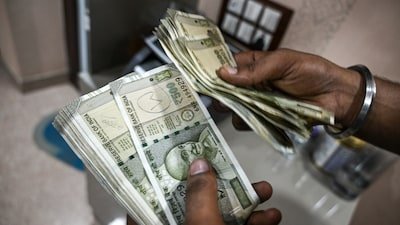
The Indian Rupee’s (INR) recent downward spiral may finally be hitting a hard floor. Following a major suite of policy interventions unveiled by the Reserve Bank of India (RBI) and the government on June 5, Wall Street heavyweight Goldman Sachs has declared that depreciation pressures on the domestic currency are set to ease significantly.
Goldman’s analysts, including Kamakshya Trivedi, noted that the aggressive steps taken to incentivize foreign capital will effectively cap the currency’s slide, paving the way for a “plateau in the dollar/rupee cross rate.”
Why the Interventions Were Critical
The policy pivot arrives at a highly sensitive moment for India’s external ledger. Just last month, a perfect storm of soaring global crude oil prices and record-breaking foreign portfolio equity outflows dragged the Rupee down to an all-time low of 96.9650 per dollar.
The velocity of that drop had triggered intense panic across trading desks, with multiple market participants speculatively positioning for a catastrophic slide toward 100 per dollar.
The $50 Billion Capital Magnet
To short-circuit this bearish momentum, authorities rolled out a powerful array of structural incentives designed to pull global fixed-income allocators into the domestic market:
-
Tax Holiday on Sovereigns: Complete tax exemptions on foreign institutional investments made into Indian Government Securities (G-Secs).
-
Bond Market Opening: Opening up major new categories of corporate and sovereign debt to uninhibited overseas capital via the Fully Accessible Route (FAR).
-
Banking Inflow Relief: Total reserve exemptions for domestic commercial banks raising capital via foreign-currency bonds and non-resident deposits.
The Inflow Projection: Market analysts estimate that these synchronized fiscal and monetary sweetners could draw between $40 billion and $50 billion in fresh foreign inflows into India over the next 12 months.
Goldman Sachs Resets the USD/INR Trajectory
Reflecting the impact of these capital buffers, Goldman Sachs has officially revised its near-term currency forecasts. While the bank is confident the slide is arrested, it clarifies that investors should not expect a major near-term appreciation rally either.
Why a Sharp Rupee Appreciation is Unlikely
Goldman emphasizes that any fresh waves of incoming global liquidity will be systematically absorbed by the central bank rather than being allowed to drive the spot value of the Rupee drastically higher. The RBI has two primary structural agendas for incoming dollars:
-
Rebuilding the Forex Chest: Re-fortifying India’s core foreign exchange reserve buffers which were drawn down during recent currency defense operations.
-
Unwinding Short Forwards: Aggressively clearing out the central bank’s massive $110 billion net short dollar forward book, which was deployed to contain the initial shock of the West Asia crisis.
The Carry Trade Comeback
For global currency traders, the macro arithmetic behind the Rupee has completely transformed. Following the intensification of regional friction in West Asia, the Rupee’s “carry” (the return generated by borrowing in a low-interest-rate currency to invest in a higher-yielding one) has widened significantly.
Thanks to the combination of the RBI’s hawkish policy stance and the currency’s recent correction, the Rupee now boasts a superior risk-adjusted carry profile compared to traditional Asian high-yield peers like the Indonesian Rupiah (IDR) and the Philippine Peso (PHP).
The Valuation Verdict: According to Goldman’s quantitative models, the Rupee has transitioned into one of the most fundamentally undervalued emerging market currencies within the global high-yield complex. Consequently, the bank concludes that there is now an incredibly compelling tactical case for global asset managers to actively add the Rupee back into diversified EM carry baskets.
