

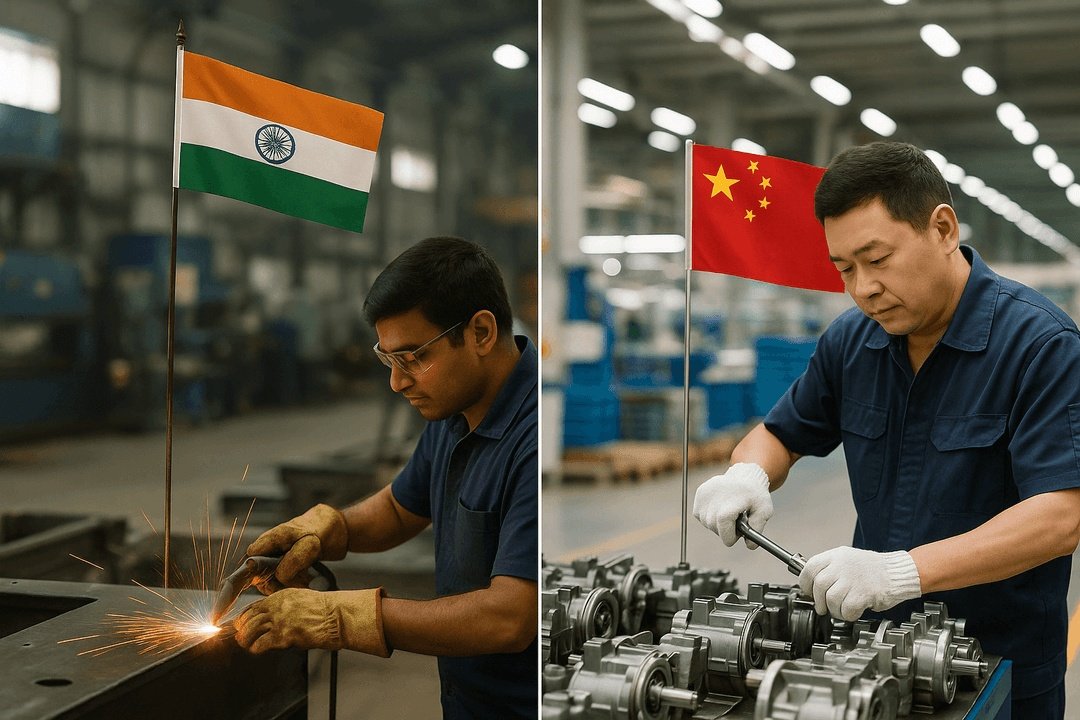
A major structural shift is accelerating in global trade as India begins to “turn the tables” on China, transitioning from a consumer of Chinese goods to a formidable competitor in high-value manufacturing and exports. Driven by a combination of geopolitical realignment and aggressive domestic policy, the “Great Supply Chain Flip” is now visible across several critical sectors.
Key Pillars of the “Flip”
1. The High-Tech Exodus (Electronics & Semi-conductors) India has successfully leveraged the “China Plus One” strategy of global tech giants.
-
Mobile Sovereignty: Once a massive importer of handsets, India is now the world’s second-largest mobile phone manufacturer. The expansion of the PLI (Production Linked Incentive) scheme has seen companies like Apple and Samsung move a significant portion of their global supply chains to Indian hubs in Tamil Nadu and Uttar Pradesh.
-
Semi-conductor Push: With the groundbreaking of multiple fabrication units in 2024-25, India is positioning itself to break China’s stranglehold on the foundational components of modern electronics.
2. Global Market Share Gains India is making inroads into traditional Chinese strongholds:
-
Textiles & Apparel: As global brands seek to diversify away from Xinjiang-linked supply chains, Indian textile hubs are seeing a surge in orders from the US and EU.
-
Specialty Chemicals: Environmental crackdowns and rising labor costs in China have allowed Indian chemical manufacturers to capture a larger share of the global market, particularly in the pharmaceutical and agrochemical segments.
3. Infrastructure and Logistics Leap A historical bottleneck for India has been the “cost of doing business.” The government is now closing the gap:
-
Gati Shakti & Dedicated Freight Corridors: Massive investments in rail and road infrastructure are finally bringing Indian logistics costs closer to global benchmarks.
-
Port Modernization: The automation of major ports like Mundra and Jawaharlal Nehru Port Trust (JNPT) has significantly reduced turnaround times, making Indian exports more time-competitive with Chinese shipments.
Strategic & Geopolitical Drivers
-
Trade Defensive Measures: India has maintained a firm stance on curbing low-quality Chinese imports through Quality Control Orders (QCOs) and anti-dumping duties, forcing a shift toward domestic procurement.
-
The “Islamabad” and “Hormuz” Factors: As highlighted in recent diplomatic developments, India’s ability to maintain resilient trade routes—even while global chokepoints face pressure—has boosted its reputation as a “reliable partner” compared to the more volatile geopolitical positioning of its regional rival.
-
FDI Preferences: As recent data shows, global capital is increasingly favoring India, with FDI inflows reaching record highs ($47.87 billion in equity for Apr-Dec FY26) as investors seek more transparent and stable regulatory environments.
The Challenges Ahead
While the flip has begun, analysts suggest that for India to fully “turn the tables,” it must continue to:
-
Reduce Input Dependence: India still relies on China for certain raw materials and APIs (Active Pharmaceutical Ingredients).
-
Upskill the Workforce: Closing the productivity gap with Chinese factory workers remains a top priority for the next phase of the industrial expansion.
The Verdict: The “Great Supply Chain Flip” is no longer just a theoretical ambition; it is an active economic reality. By combining scale, democratic stability, and a rapidly improving industrial base, India is fundamentally altering the map of global trade.
