

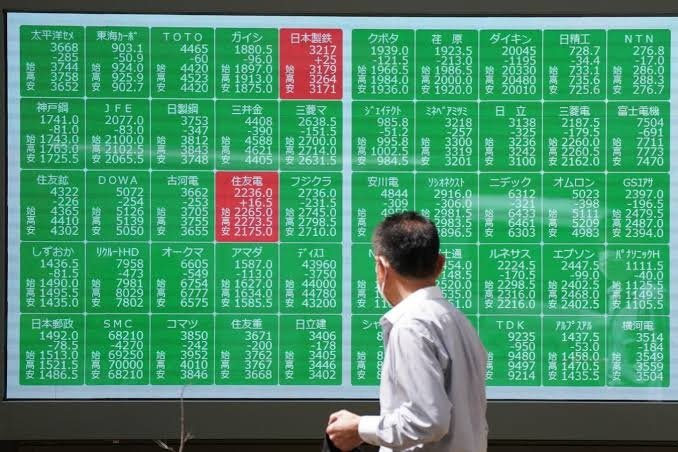
Global fund managers staged their most aggressive weekly exit from Japanese equity markets in months, aggressively locking in profits from the high-flying technology sector. The massive exodus highlights a broader international shift as investors grow cautious over stretched artificial intelligence (AI) valuations and debt-fueled corporate tech spending.
According to latest data from Japan’s Ministry of Finance, foreign investors offloaded a net ¥1.82 trillion ($11.2 billion) in Japanese shares during the week ended June 27. This marks the single largest weekly outflow from the country’s stock market since March 28, dragging the tech-heavy Nikkei 225 index down 2.7% over the period.
The Capital Flight Beyond Equities
The foreign retreat wasn’t isolated to the stock market. International capital pulled out across multiple Japanese asset classes simultaneously:
-
Equities: ¥1.82 trillion ($11.2 billion) net outflow.
-
Short-Term Bills: Foreign investors dumped a massive ¥2.43 trillion.
-
Long-Term Bonds: Fixed-income markets recorded their fourth consecutive week of foreign capital contraction, totaling ¥493.7 billion.
Retail Investors Step In to Cushion the Blow
While institutional money fled, local Japanese retail investors aggressively pushed back against the tide. Stepping in as a vital market stabilizer, domestic retail traders absorbed a massive portion of the selling pressure.
Data from the Japan Exchange Group Inc. revealed that local retail buyers purchased a net ¥950 billion ($5.9 billion) in equities during the exact same week. This record-breaking retail buying spree provided a critical floor for the market, preventing a more severe collapse in local equity benchmarks as global fund managers pulled the plug.
Valuation Anxieties Clash with Record Quarters
The abrupt weekly correction stands in stark contrast to the market’s long-term momentum. Despite the recent drop, the Nikkei 225 managed to lock in its strongest quarterly gain on record, fueled almost entirely by the unprecedented global wave of AI optimism.
However, market analysts warn that the initial euphoria surrounding the sector is steadily giving way to skepticism. With Wall Street and Asian markets entering a more demanding corporate earnings phase, international investors are increasingly questioning the immediate economic returns of massive AI infrastructure budgets. This growing scrutiny leaves highly exposed tech indices heavily susceptible to sudden bouts of volatility and swift institutional profit-taking.
