

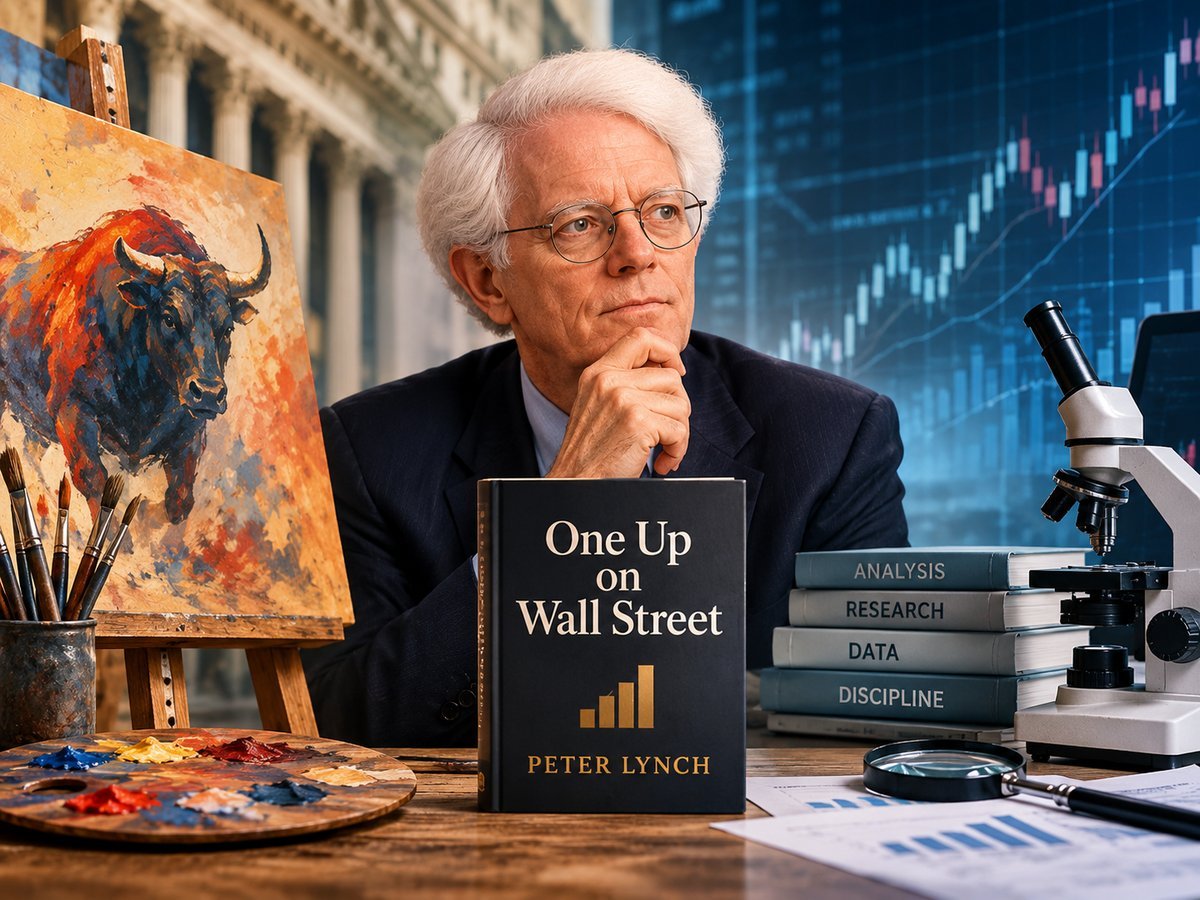
When it comes to the stock market, Wall Street has spent decades trying to brand investing as an exact science. Quants build complex algorithmic models, analysts churn out intricate DCF spreadsheets, and forecasters lean heavily on macro-economic indicators to predict the next market shift.
Yet, in his classic investment guide One Up on Wall Street, legendary Magellan Fund manager Peter Lynch famously shattered that illusion with a single, counterintuitive assertion:
“Investing in stocks is an art, not a science, and people who’ve been trained to rigidly quantify everything have a big disadvantage.”
For everyday investors, Lynch’s philosophy offers a liberating perspective on how wealth is actually built in the markets.
Why Rigid Quantification Fails
Minds trained in strict scientific disciplines look for predictable, repeatable outcomes under controlled laboratory conditions. But the stock market is not a physics experiment—it is a living, breathing reflection of human behavior, shifting consumer trends, competitive disruption, and unpredictable management decisions.
When investors rely entirely on rigid mathematical formulas and spreadsheet metrics, they often miss the qualitative forest for the quantitative trees. A company might look terrible on paper due to a temporary cyclical downturn, but if you understand its brand loyalty, local footprint, and product demand on the ground, you see an opportunity that formulas overlook.
Lynch famously noted that the actual math required for successful investing goes no further than primary school arithmetic: addition, subtraction, multiplication, and division. Beyond calculating P/E ratios and checking balance sheets, numbers are merely a diagnostic tool, not a crystal ball. By the time a company’s prospects are completely “scientific” and risk-free to a computer model, the stock price has already skyrocketed, and the easy gains have vanished.
The Real Toolkit of the “Artistic” Investor
If investing isn’t a science, what does it take to succeed? Lynch argued that superior returns come from human traits, behavioral discipline, and observational skills that anyone can cultivate.
-
Everyday Observation Over Complex Equations: Ordinary consumers and professionals often spot winning investments long before Wall Street analysts ever write a report. You notice packed parking lots at a new restaurant chain, a product your teenagers are obsessed with, or an operational inefficiency at your workplace. This grassroots reconnaissance forms the foundation of great investing.
-
Emotional Resilience and Patience: The greatest enemy of an investor is not a lack of computational horsepower; it is emotional volatility. Science demands consistent, reproducible inputs. Investing demands the psychological fortitude to watch your portfolio drop 25% during a macro panic without selling out of fear.
-
Embracing Ambiguity: An artistic approach accepts that businesses evolve, setbacks happen, and turnarounds take time. It requires evaluating a company’s “story,” its competitive moat, and the integrity of its leadership—nuances that defy automated scoring.
The Bottom Line
Wall Street wants you to believe that beating the market requires advanced calculus and Bloomberg terminals. But Peter Lynch proved that stock picking is closer to portrait painting or storytelling. It requires patience, a keen eye for human behavior, common sense, and the courage to trust your own observations over the collective panic of the crowd.
