

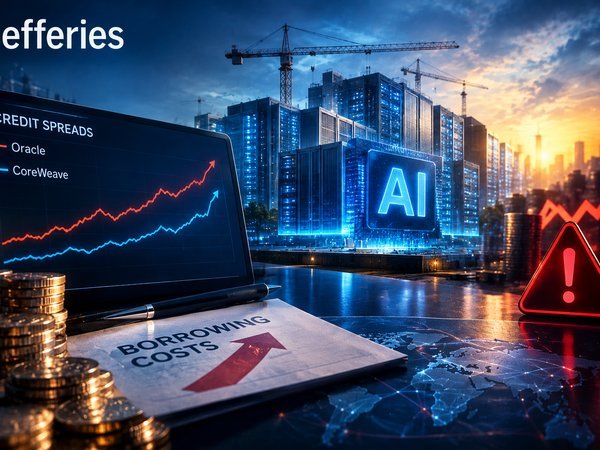
Financial markets are showing early signs of credit stress surrounding the global Artificial Intelligence (AI) investment boom. According to a research report by investment banking firm Jefferies (authored by Christopher Wood in the GREED & fear report titled “K-shaped stresses, AI tremors and the Houthis”), elevated borrowing costs and widening credit risk indicators could pose significant funding challenges for ongoing AI capital expenditure (capex).
While funding for AI projects has not ground to a halt, the report highlights rising credit risk as an early warning sign that investors must monitor closely.
Key Takeaways & Market Risk Indicators
1. Sharp Rise in Credit Spreads & Borrowing Costs
Investors are demanding higher risk premiums to fund companies heavily engaged in AI infrastructure, data center development, and computing capacity expansion:
-
Oracle: Its 5-year Credit Default Swap (CDS) spread widened significantly from 186 basis points on September 11 to 288 basis points.
-
CoreWeave: The AI cloud provider saw its CDS spread jump from 749 basis points to 1,118 basis points over the same period.
-
CoreWeave Bond Yields: The yield on CoreWeave’s 2032 maturity bond spiked to 14.8%, reflecting steep financing costs for debt-dependent infrastructure players.
Jefferies noted that these risk metrics have reached their highest levels since the AI capex cycle gained momentum in early 2023.
Slowing Earnings Growth & High Valuation Pressure
The report emphasizes that growing financing risks are coinciding with projected moderation in earnings growth, increasing pressure on tech giants to justify massive AI spending:
| Metric | Historical / Current (2026) | Projected (2027) | Projected (2028) |
| Consensus AI Earnings Growth | ~100% | ~30% | ~22% |
| Forward P/E Multiple Gap | AI Stocks: 23x Forward Earnings | Non-AI Stocks: 13x Forward Earnings | Valuation gap remains high |
Strategic Implications for the Market
-
Focus on Credit Spreads: Jefferies advises investors to stay “laser-focused on credit spreads” as an indicator of whether debt markets remain willing to underwrite the massive multi-billion-dollar capex cycle.
-
Infrastructure Dependence: Expanding AI infrastructure requires vast capital for GPUs, data centers, cooling, and power grids. Highly leveraged companies or non-hyperscalers reliant on external debt markets face the greatest squeeze.
-
Justifying ROI: With borrowing costs rising and earnings growth expected to normalize from explosive tripling rates down to ~20-30%, companies will face stricter scrutiny from public and private markets to demonstrate clear Returns on Investment (ROI) from AI deployments.
