

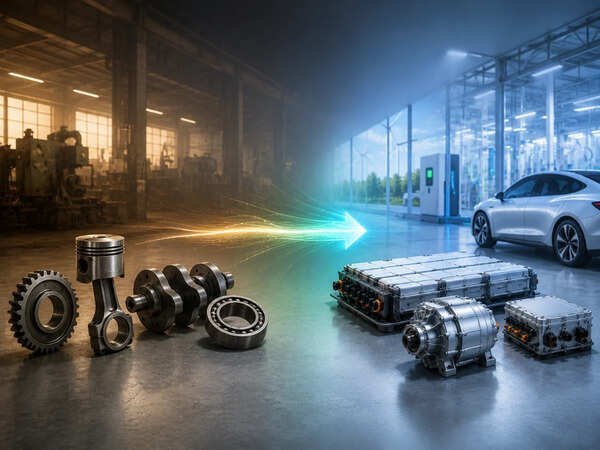
The Indian auto ancillary sector has evolved significantly. A few years ago, the dominant market narrative revolved entirely around EV survival risk—which suppliers would be disrupted and which could successfully transition their product suites to Electric Vehicles (EVs).
That uncertainty has largely settled. The market now clearly distinguishes between companies that successfully navigated the EV transition and those left behind. Today, analyst focus and valuation re-ratings center around a new narrative: Strategic Diversification & Value Addition.
Key Drivers of the Potential Sector Re-Rating
-
Shift from EV Survival to Diversification:
Leading auto component manufacturers are no longer just supplier options for traditional Internal Combustion Engine (ICE) original equipment manufacturers (OEMs). They are actively diversifying into non-auto verticals—such as aerospace, defense, industrial automation, electronics, and medical equipment—while simultaneously scaling up content per vehicle in EVs (e.g., thermal management, lightweighting, electronic control units, advanced lighting).
-
Tailwinds from GST Rationalization & Domestic Demand:
Post-GST rate rationalizations, alongside steady demand trends, OEMs have maintained healthy order books. As primary OEM production ramps up to meet festive season demand across passenger vehicles, two-wheelers, and commercial vehicles, auto ancillary companies benefit from dual tailwinds of volume growth and higher realization per unit.
-
Premiumization & Export Opportunities:
Beyond domestic demand, global OEMs are increasingly looking to India as a primary sourcing hub under “China+1” supply chain strategies. Higher adoption of advanced driver-assistance systems (ADAS), premium cabin interiors, sunroofs, and smart electronics has significantly increased the average content value per vehicle.
Evaluating Auto Ancillary Stocks for Up to 30% Upside
When looking for re-rating candidates with up to 25–30% potential upside, analysts generally screen auto ancillary companies based on four critical filters:
1. High Content per Vehicle (EV & Premium ICE Neutrality)
-
Focus: Companies whose components are required regardless of the powertrain (ICE vs. EV), such as advanced lighting, wiring harnesses, seating systems, suspension, and braking assemblies.
-
Why it Matters: Eliminates engine-type risk while capturing the trend of premiumization.
2. Active Non-Auto Diversification
-
Focus: Component makers expanding into high-margin segments like defense engineering, railway components, power tools, and consumer electronics.
-
Why it Matters: Reduces cyclical reliance on automobile sales volumes and improves overall margin profiles.
3. Clean Financials & Healthy ROCE
-
Focus: Low debt-to-equity ratios, high Return on Capital Employed (ROCE > 18–20%), and strong Cash Flow from Operations (CFO).
-
Why it Matters: Ensures the company can fund ongoing CapEx without diluting equity or stretching balance sheets during macro sell-offs.
4. Strong OEM Relationships & Global Footprint
-
Focus: Suppliers with long-standing contracts with top domestic OEMs (Maruti Suzuki, Hyundai, M&M, Tata Motors) and expanding export order books.
Strategic Takeaway for Investors
-
Focus on Quality & Realization Growth: The next phase of outperformance in auto ancillaries will not come purely from volume growth, but from companies that are increasing their content value per vehicle and expanding into high-margin adjacent industries.
-
Risk Management: Given broader market volatility and geopolitical headlines, build exposure to high-conviction auto ancillary stocks in a staggered manner (SIP on dips) rather than committing lump-sum capital.
