

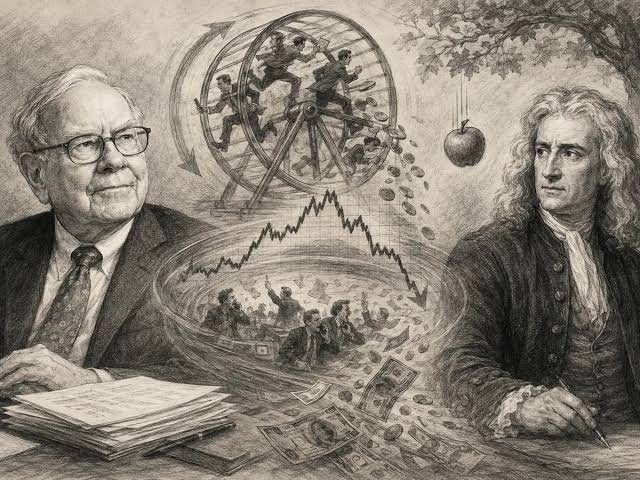
Somewhere between what your investments earn and what you actually keep, a portion goes missing every year. It is charged by nobody you could name and appears on no statement you will ever receive.
Warren Buffett worked out where it goes, why almost no investor escapes it, and how large it has quietly become. He then reduced the whole thing to a single law of motion that Sir Isaac Newton—who lost a fortune in the markets—never got around to discovering.
The Genius Who Stumbled: Isaac Newton and the South Sea Bubble
Sir Isaac Newton, the genius who unlocked gravity and formulated the fundamental laws of classical physics, was undeniably brilliant. Yet, when it came to the financial markets, even his formidable intellect couldn’t protect him from human emotion.
In the early 1700s, during the infamous South Sea Bubble, Newton was an early investor in the South Sea Company. Sensing a speculative frenzy, he sold his shares early and walked away with a handsome £7,000 profit (a fortune at the time).
However, as the stock price continued its parabolic rise, FOMO (Fear Of Missing Out) set in. Watching his friends and neighbors grow wildly rich on paper, Newton bought back into the stock near its absolute peak. When the bubble inevitably burst, he lost roughly £20,000—equivalent to millions of dollars today.
Chastened by the experience, Newton famously remarked:
“I can calculate the movement of the stars, but not the madness of men.”
For the rest of his life, Newton reportedly forbade anyone from uttering the words “South Sea” in his presence.
Buffett’s Insight: The “Fourth Law of Motion”
In his 2005 annual letter to Berkshire Hathaway shareholders, Warren Buffett reflected on Newton’s catastrophic trade and proposed an extension to physics:
“Long ago, Sir Isaac Newton gave us three laws of motion, which were the work of genius. But Sir Isaac’s talents didn’t extend to investing… If he had not been traumatized by this loss, Sir Isaac might well have gone on to discover the Fourth Law of Motion: For investors as a whole, returns decrease as motion increases.”
The “Helpers” and the Hidden Tax of Friction
Why do returns fall when motion increases? Buffett illustrated this using a simple thought experiment featuring a fictional wealth family called the Gotrocks:
-
The Gotrocks Family: Imagine that a single family owns 100% of corporate America. Year after year, they collect dividends and earnings, growing steadily richer as a unified group.
-
Enter the “Helpers”: Fast-talking brokers and managers convince family members to trade stock back and forth to outsmart one another. The family still owns 100% of corporate America, but every trade carries a fee.
-
The Layering of Fees: Soon come the financial consultants, active fund managers, hedge funds, and performance-fee structures.
Overall corporate profits didn’t decrease, but the family’s share of those profits shrank because a massive cut was being siphoned off by intermediaries—the “Helpers”.
The Frictional Costs Squeezing Your Portfolio
| Frictional Cost | How It Erode Wealth |
| Transaction Fees & Spreads | Frequent buying and selling incurs brokerage commissions and bid-ask spread losses. |
| Active Management Fees | High expense ratios cut into compounding returns regardless of whether the fund beats the market. |
| Capital Gains Taxes | Every realization of profit triggers short-term tax liabilities, cutting short the process of compounding interest. |
| Behavioral Slippage | Trying to time market highs and lows often leads to buying near the top and selling near the bottom. |
Buffett estimated that these collective frictional costs can consume 20% or more of the underlying earnings generated by businesses.
How Modern Investors Can Escape the Trap
Newton’s primary mistake was twofold: letting crowd psychology dictate his timing and over-trading outside his core competence. To avoid similar traps, individual investors should adopt a few key principles:
-
Inertia is a Superpower: Long-term buy-and-hold strategies minimize frictional drag from taxes and fees, leaving more capital to compound over decades.
-
Embrace Low-Cost Indexing: Broad-market index funds eliminate the need for costly stock-pickers and market timers, helping you keep the majority of what the market generates.
-
Stay Within Your Circle of Competence: Avoid buying into speculative manias simply because everyone around you seems to be making quick money.
The Bottom Line: In physics, motion creates energy. In investing, excess motion primarily creates fees. As Warren Buffett reminds us, sitting still and doing less is often the most profitable move an investor can make.
