

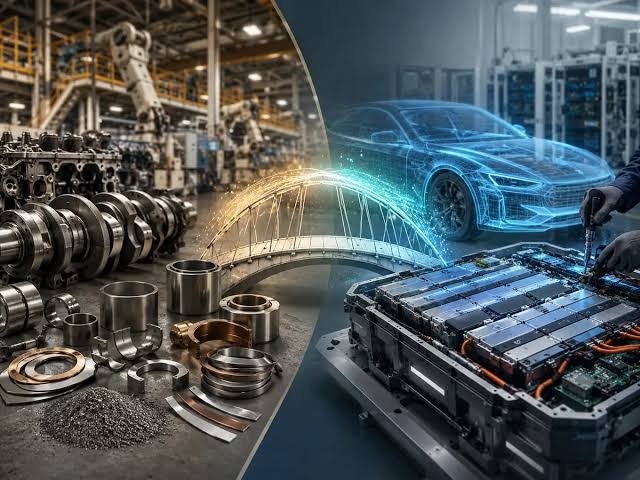
A 65-year-old auto component manufacturer delivered headline revenue growth of 24.2% in FY26. Beneath the hood, however, margin dilution in its core business and nascent EV timelines reveal a classic transition trap.
The Headline Illusion
In the world of small-cap auto component suppliers, a 24.2% top-line surge usually signals an operational turnaround or market share expansion. For this 65-year-old auto ancillary maker—backed by integrated manufacturing plants, a decades-long operating track record, and stable promoter ownership—FY26 appeared on paper to be a banner year. Driven by higher export volumes and a brand-new stream of engineering services revenue, the headline figures delivered everything growth investors look for.
Yet, a closer examination of the segment disclosures reveals an underlying structural challenge.
While total revenue expanded, operating profitability in the legacy core business actually contracted. The incremental profit that supported the year’s financial performance came largely from a newly added engineering division, while the company’s long-term bet on electric vehicles (EVs) remains firmly in its infancy.
This brings a central valuation question to the forefront: Is this new engineering income a repeatable structural pivot, or merely a temporary cushion masking core margin erosion?
Anatomy of the FY26 Earnings Mix
The company’s latest financial breakdown illustrates the delicate balancing act faced by traditional Internal Combustion Engine (ICE) component suppliers transitioning into a low-carbon ecosystem.
1. Core Margin Compression
Growing revenue while losing segment margin is a classic sign of eroding pricing power or adverse cost dynamics. Tier-1 and Tier-2 component suppliers frequently face delayed pass-through mechanisms with OEMs when raw material and freight costs fluctuate. When volume growth fails to yield operating leverage in the primary business line that defines a company’s identity, top-line metrics become deceptive.
2. The Engineering Cushion
Engineering and design services typically command higher gross margins than heavy metal-forming or component assembly. In FY26, this new revenue vertical contributed a disproportionate share of total segment profit. While diversification is positive, engineering contracts can be lumpy, project-based, or cyclical. Treating non-recurring engineering income as high-multiple recurring earnings can lead to mispriced valuations.
3. The EV Timeline Gap
Like many legacy suppliers, the company has announced plans to capture content per vehicle in the emerging EV supply chain. However, the EV-linked division is currently at a nascent stage. Bridging the gap between conceptualizing EV components and securing commercial platform wins with major OEMs requires significant lead time, rigorous qualification cycles, and sustained capital outlay.
The Strategic Dilemma: Multibagger potential or structural drag?
This dynamic is central to small-cap auto ancillary investing today. As the broader auto component sector navigates shifting powertrain technologies, small caps sit on a spectrum ranging from high-leverage turnarounds to financially strained distress cases.
“The critical question for investors isn’t whether legacy component makers want to transition to EVs—it’s whether their traditional cash cows can generate enough margin to fund the journey without diluting shareholder capital.”
When an auto ancillary uses short-term engineering or consulting income to offset structural weakness in its core manufacturing engine, it creates an operational bridge. But for that bridge to lead to long-term wealth creation, two things must happen:
-
Core manufacturing margins must stabilize through operational efficiencies and pricing adjustments.
-
EV initiatives must transition from pilot projects to scaled, commercial production.
What Investors Should Track Next
For market participants assessing whether this supplier can turn its current challenges into an opportunity, three key metrics will determine the trajectory:
-
Core Segment EBITDA Margin (Ex-Engineering): Is the legacy ICE business restoring its operational profitability, or is margin compression becoming structural?
-
Order-Book Sticky Ratio: What percentage of the new engineering income represents long-term, multi-year service retainers versus one-off consulting assignments?
-
EV Commercialization Velocity: Are capital expenditures in the EV division translating into tangible OEM platform inclusions and validated order books?
The Bottom Line
Headline revenue growth of 24.2% provides a welcome narrative, but sustainable performance depends on cash-flow quality. Until the nascent EV business achieves operational scale, the company’s near-term narrative will hinge on whether its core manufacturing business can regain its footing without relying endlessly on non-core stopgaps.
