

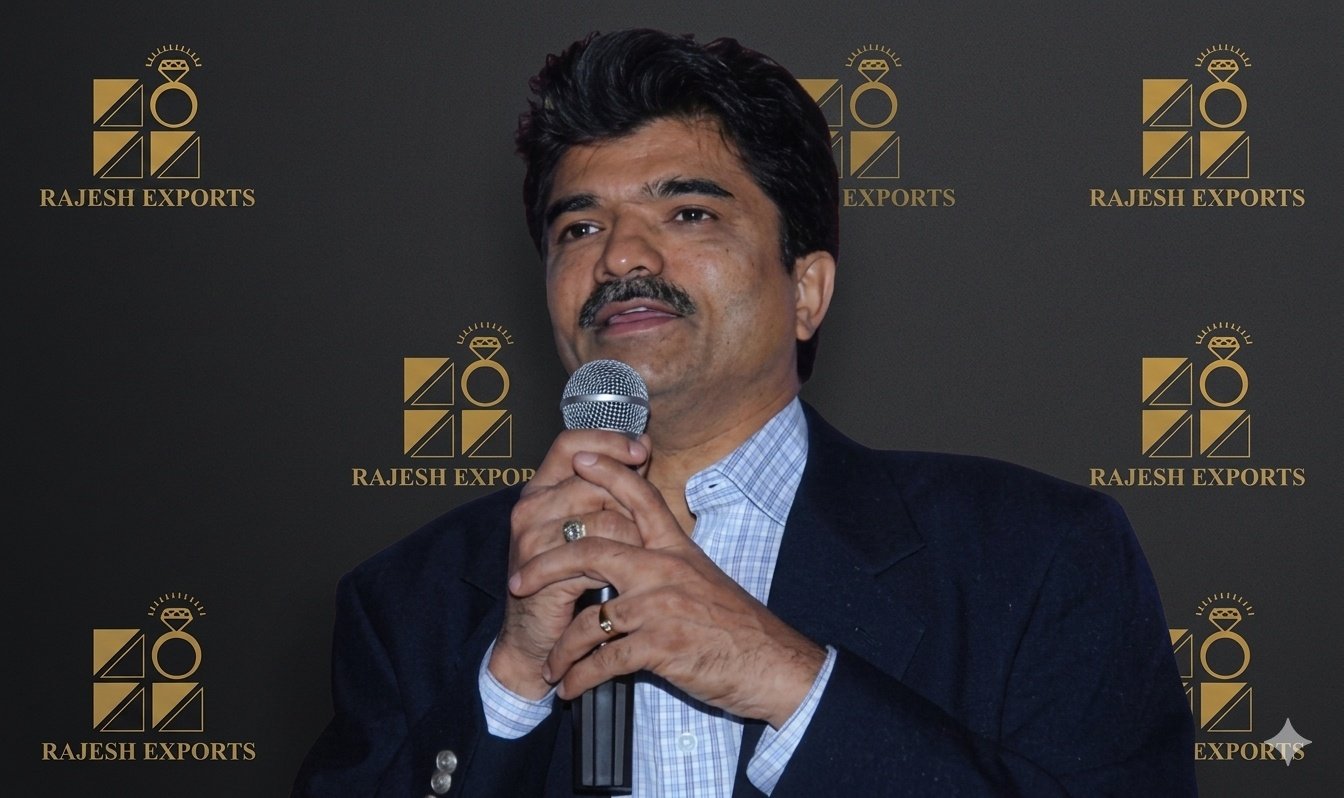
Shares of gold exporter Rajesh Exports plunged sharply this week, losing over 16 percent of their value and hitting consecutive 5 percent lower circuits to close at ₹98.73. The aggressive sell-off follows a devastating 109-page interim ex-parte order issued by the Securities and Exchange Board of India (SEBI), which has triggered intense corporate governance concerns across Dalal Street.
The crisis has prompted market analysts to draw alarming parallels to the Gensol Engineering scandal of 2025, raising critical questions about accounting transparency and promoter integrity in India’s corporate sector.
The Core Allegations: Phantom Revenues and Subsidiary Secrecy
At the center of SEBI’s investigation is the allegation that Rajesh Exports systematically misrepresented ₹15.15 lakh crore (approx. US$180 billion) in consolidated revenue over a five-year period between FY21 and FY25. According to the regulator, this astronomical figure accounts for a staggering 99.8 percent of the total revenue attributed to the company’s subsidiaries.
SEBI’s prima facie findings highlight a deeply concerning structural pattern:
-
Subsidiary Reliance: Between 97% and 99% of Rajesh Exports’ massive consolidated revenue originated from overseas subsidiaries—primarily Swiss gold refinery Valcambi SA.
-
The Disclosure Gap: Despite the business being completely dependent on these subsidiaries, the parent company allegedly failed to place the actual financial statements of these entities into the public domain for investors to verify.
-
The Paper Trail Failure: When SEBI investigators attempted to reconcile the declared consolidated numbers with underlying records at the subsidiary level, the numbers simply did not match.
Circular Trading and Fund Diversion
The regulatory order goes far beyond a mere international accounting disagreement. SEBI has flagged serious red flags within the company’s standalone operations in India:
-
The Affluence Disconnect: Rajesh Exports recorded ₹11,487 crore in sales and ₹11,488 crore in purchases with an entity named Affluence Shares and Stocks Private Limited between FY22 and FY24. These entries made up roughly two-thirds of the parent company’s standalone business. However, Affluence completely denied having any business relationship, contracts, or invoices with Rajesh Exports.
-
Promoter Fund Diversion: SEBI alleges that corporate funds worth ₹339 crore were covertly routed directly into the personal accounts of Chairman Rajesh Mehta. The regulator claims these funds were used for personal derivative trading, entirely bypassing mandatory board or audit committee approvals.
-
Receivable Adjustments: The company allegedly wiped out ₹2,914 crore in long-standing trade receivables from overseas entities by simply adjusting them against trade payables without proper formal agreements or transparent disclosures.
The Company Defense: “A Misunderstanding of EBITDA”
Rajesh Exports and its promoter, Rajesh Mehta, have strongly denied any criminal intent or fraudulent behavior. In an official clarification released on June 4, the company claimed that SEBI’s interim order does not represent a conclusive adverse finding or an official penalty.
The management argued that the massive discrepancy highlighted by the regulator stems from a fundamental accounting misunderstanding regarding its Swiss subsidiary, Valcambi:
“The core observation in the order is with regard to the mis-reporting of the revenues. This has emerged primarily due to confusion because SEBI has considered the EBITDA (Earnings Before Interest, Taxes, Depreciation, and Amortization) of Valcambi instead of revenue. The consolidated revenue as stated by the company is correct.”
Is It the Next Gensol? Analysts Weigh In
The market’s swift reaction reflects the painful memories of the 2025 Gensol Engineering crisis, where promoters diverted over ₹260 crore of corporate funds to finance lavish lifestyles, leading to a catastrophic 80% to 90% collapse in shareholder wealth.
While the underlying mechanics differ—Gensol involved direct asset stripping while Rajesh Exports centers on massive revenue inflation—financial experts warn that the erosion of investor trust is identical.
Hariprasad K (Founder, Lifelong Wealth): “The allegations have fundamentally changed the investment debate from earnings and valuation to credibility and transparency. The key question is no longer whether the stock is cheap, but whether investors can rely on the reported financial statements. The market is no longer valuing the company based on growth expectations but is instead discounting it for regulatory, legal, and governance risks.”
Ponmudi R (CEO, Enrich Money): “Governance risk often commands a larger discount than business risk. Investors can tolerate cyclical challenges, industry headwinds, and temporary earnings pressure. What they struggle to price is uncertainty around the credibility of reported financials and corporate disclosures. Until regulatory proceedings conclude, investors will treat this purely as a governance-risk stock.”
Nitant Darekar (Research Analyst, Bonanza): “Both cases involve allegations relating to promoter fund diversion and questionable paper trails rather than a struggling operating business. SEBI’s findings on revenue reporting, counterparty transactions, and funds routed to promoter-linked accounts represent significant governance red flags. Investors should remain on the sidelines until greater clarity emerges.”
The Collateral Damage: Banks and Institutional Exposure
The fallout from SEBI’s interim order is already spilling over into the broader banking and financial sectors. State-run lender Canara Bank announced that Rajesh Exports has defaulted on its repayment obligations, prompting the bank to classify its ₹509 crore exposure as a stressed asset. Canara Bank has already moved to offload this debt via an open auction.
Meanwhile, institutional heavyweight Life Insurance Corporation of India (LIC) remains caught in the crossfire, holding a major 10.8 percent equity stake in the company. In total, SEBI estimates that the ongoing governance crisis has wiped out approximately ₹12,726 crore in shareholder wealth, leaving retail and institutional investors to bear the brunt of the damage while both Rajesh Exports and Rajesh Mehta remain barred from the securities market.
